®
Summer 2026
page 26
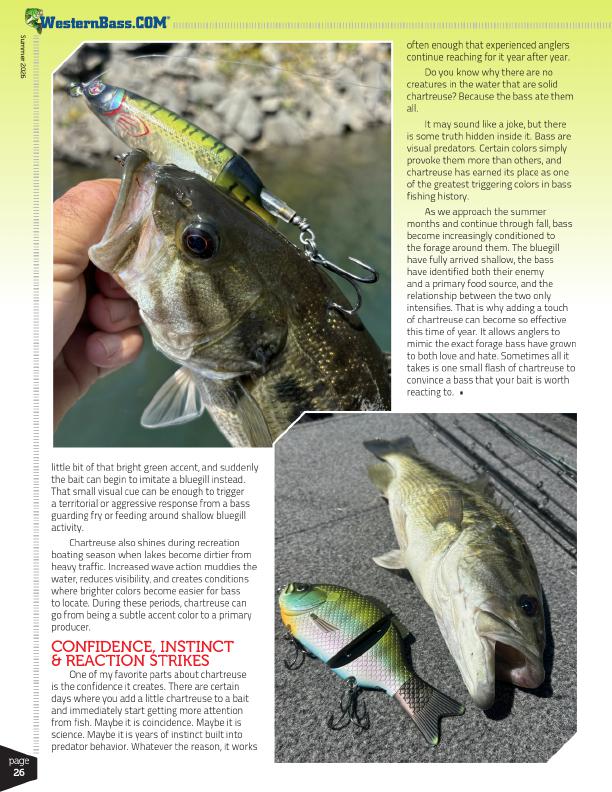
little bit of that bright green accent, and suddenly the bait can begin to imitate a bluegill instead. That small visual cue can be enough to trigger a territorial or aggressive response from a bass guarding fry or feeding around shallow bluegill activity.
Chartreuse also shines during recreation boating season when lakes become dirtier from heavy traffic. Increased wave action muddies the water, reduces visibility, and creates conditions where brighter colors become easier for bass to locate. During these periods, chartreuse can go from being a subtle accent color to a primary producer.
CONFIDENCE, INSTINCT & REACTION STRIKES
One of my favorite parts about chartreuse is the confidence it creates. There are certain days where you add a little chartreuse to a bait and immediately start getting more attention from fish. Maybe it is coincidence. Maybe it is science. Maybe it is years of instinct built into predator behavior. Whatever the reason, it works
often enough that experienced anglers continue reaching for it year after year.
Do you know why there are no creatures in the water that are solid chartreuse? Because the bass ate them all.
It may sound like a joke, but there is some truth hidden inside it. Bass are visual predators. Certain colors simply provoke them more than others, and chartreuse has earned its place as one of the greatest triggering colors in bass fishing history.
As we approach the summer months and continue through fall, bass become increasingly conditioned to the forage around them. The bluegill have fully arrived shallow, the bass have identified both their enemy and a primary food source, and the relationship between the two only intensifies. That is why adding a touch of chartreuse can become so effective this time of year. It allows anglers to mimic the exact forage bass have grown to both love and hate. Sometimes all it takes is one small flash of chartreuse to convince a bass that your bait is worth reacting to. •