®
C
hartreuse may be one of the most
misunderstood colors in bass fishing. Many
anglers view it as an unnatural color suited only for muddy water or loud reaction baits. The truth
is, chartreuse absolutely exists in nature, and in some
situations, it can trigger responses from a bass that
wouldn’t normally bite a presentation absent of the color.
In many situations, like the ones previously mentioned,
full chartreuse can be deadly. However, when fishing clear
reservoirs the saying “a little goes a long way” proves true.
WHY BASS REACT TO CHARTREUSE
One of the biggest reasons this color can be so effective revolves around bluegill. Bluegill have a light dash of chartreuse on their tails and around their fins. Bass hate bluegill, but in a good way for anglers. They feed on them, yes. But more often than not they attack them out of aggression, and that little green tail works as a perfect attractant to have your presentation noticed.
On many clear-water reservoirs, bass will spawn first. The fry hatch and begin to gather in shallow water, guarded closely by male bass protecting them. Shortly afterward, bluegill begin moving shallow to spawn as water temperatures continue to rise. This creates a natural conflict where both species are forced to cross paths and inhabit the same water.
Bluegill are notorious for feeding on bass fry, and bass become extremely territorial during this period. The larger female bass have also just endured a lengthy pre-spawn and spawn. At this point in time, they are exhausted and eager to regain strength and body weight. They are vulnerable, defensive, and highly aware of anything that resembles a threat.
Over time, I have come to believe bass begin associating flashes of chartreuse with danger to their offspring. That is why chartreuse can trigger such violent reaction bites during the post-spawn period, especially around shallow cover, fry guarders, and bluegill-spawning areas.
TRIGGERING TERRITORIAL BASS
In many cases, bass are not feeding because they are hungry. They are reacting because they are protective. Bluegill are the enemy.
Bass have a level of tolerance. A shad or crawfish are both acceptable meal options that can move through an area without creating panic. However, when it comes to bluegill around fry, the tolerance level disappears quickly. If bluegill enter the protected zone, they must either be escorted out or eliminated. That is where chartreuse becomes so important.
WHY LESS CHARTREUSE OFTEN WORKS BETTER
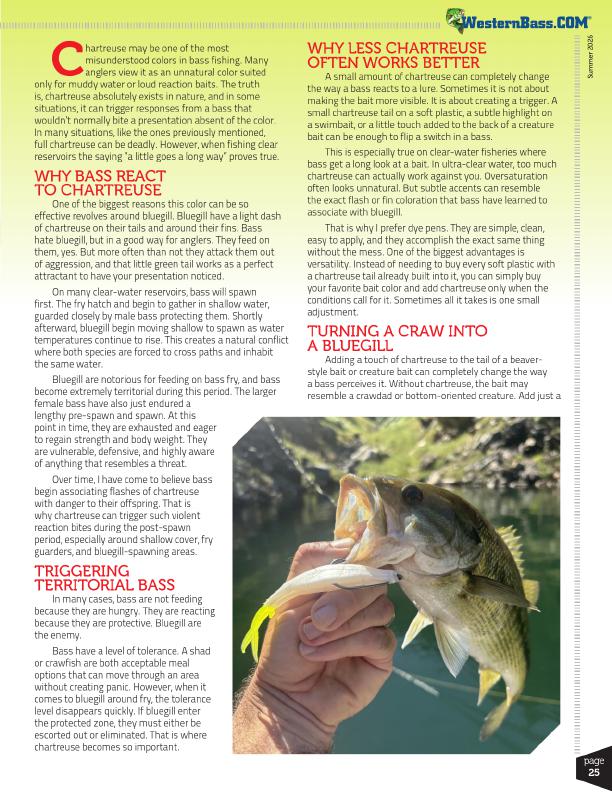
A small amount of chartreuse can completely change the way a bass reacts to a lure. Sometimes it is not about making the bait more visible. It is about creating a trigger. A small chartreuse tail on a soft plastic, a subtle highlight on a swimbait, or a little touch added to the back of a creature bait can be enough to flip a switch in a bass.
This is especially true on clear-water fisheries where bass get a long look at a bait. In ultra-clear water, too much chartreuse can actually work against you. Oversaturation often looks unnatural. But subtle accents can resemble the exact flash or fin coloration that bass have learned to associate with bluegill.
That is why I prefer dye pens. They are simple, clean, easy to apply, and they accomplish the exact same thing without the mess. One of the biggest advantages is versatility. Instead of needing to buy every soft plastic with a chartreuse tail already built into it, you can simply buy your favorite bait color and add chartreuse only when the conditions call for it. Sometimes all it takes is one small adjustment.
TURNING A CRAW INTO A BLUEGILL
Adding a touch of chartreuse to the tail of a beaver- style bait or creature bait can completely change the way a bass perceives it. Without chartreuse, the bait may resemble a crawdad or bottom-oriented creature. Add just a
Summer 2026
page 25