Spring/Early Summer 2026
page 26
®
bait to fall straight to the bottom instead of gliding naturally through the water column.
When bass move shallow, downsizing the jig head to 1/16- or 1/8-ounce can create a more natural presentation. Often the bite is subtle – you may simply see your line move rather than feel the strike. Watching your line carefully and reacting quickly can lead to more hooked fish.
WHY STICKBAITS SHINE IN WARMING WATER
As bass continue moving into shallow flats and emerging weed growth, they begin feeding heavily in preparation for the spawn. During this period, suspending stickbaits become extremely effective because they remain in the strike zone longer than many other lures.
Unlike faster-moving baits, stickbaits allow anglers to work a lure slowly in place without pulling it away from fish too quickly.
One of my go-to options is the SPRO McStick 110, which runs in the 3o to f-foot range. I also carry the SPRO McStick 110+1, which can reach depths of 9- to 12-feet.
If I need to modify my bait, I will add a Storm Suspend Strip under the bill. This slightly changes the bait’s angle, allowing it to dive deeper and faster while also helping it hold position during the pause.
When bass are lethargic, I may also add a suspend dot or strip to the belly of the bait. This helps keep the lure suspended longer in the strike zone and often triggers bites from neutral or reluctant fish.
Cadence is extremely important when fishing stickbaits. Experiment with different retrieves to determine what triggers strikes that day. If you have Forward Facing Sonar (FFS), it can help identify how bass react to your
presentation. Watching how fish respond to your bait can provide valuable clues on when to adjust cadence or change presentations.
COVERING WATER WITH SPINNERBAITS AND VIBRATING JIGS
Two other valuable early spring baits are spinnerbaits and vibrating jigs. As bass move toward spawning areas, anglers often need to cover water quickly to locate active fish. Spinnerbaits and vibrating jigs create an effective one-two punch that allows anglers to search large areas efficiently.
While using these baits, pay close attention to visible structure and potential spawning areas. Make several casts before getting too close to avoid spooking fish.
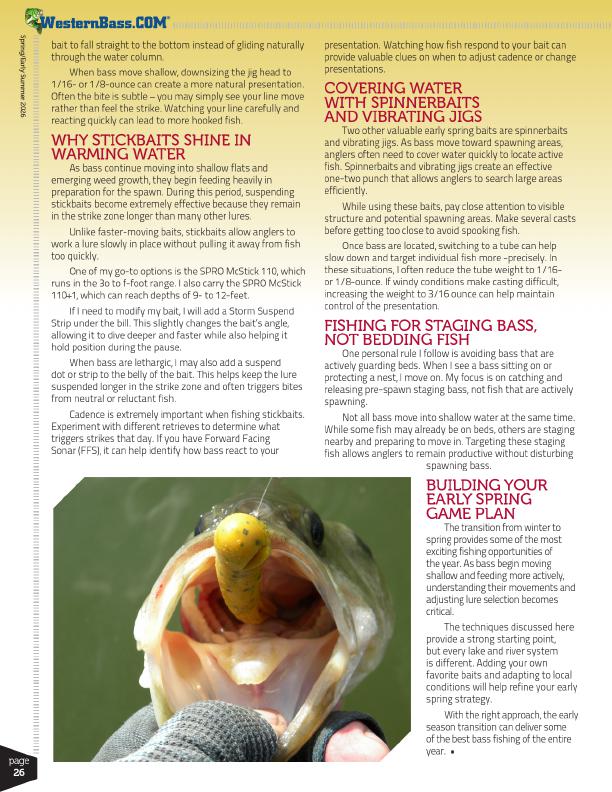
Once bass are located, switching to a tube can help slow down and target individual fish more -precisely. In these situations, I often reduce the tube weight to 1/16- or 1/8-ounce. If windy conditions make casting difficult, increasing the weight to 3/16 ounce can help maintain control of the presentation.
FISHING FOR STAGING BASS, NOT BEDDING FISH
One personal rule I follow is avoiding bass that are actively guarding beds. When I see a bass sitting on or protecting a nest, I move on. My focus is on catching and releasing pre-spawn staging bass, not fish that are actively spawning.
Not all bass move into shallow water at the same time. While some fish may already be on beds, others are staging nearby and preparing to move in. Targeting these staging fish allows anglers to remain productive without disturbing
spawning bass.
BUILDING YOUR EARLY SPRING GAME PLAN
The transition from winter to spring provides some of the most exciting fishing opportunities of the year. As bass begin moving shallow and feeding more actively, understanding their movements and adjusting lure selection becomes critical.
The techniques discussed here provide a strong starting point, but every lake and river system is different. Adding your own favorite baits and adapting to local conditions will help refine your early spring strategy.
With the right approach, the early season transition can deliver some of the best bass fishing of the entire year. •