®
Spring 2025
page 42
cove. This way, I cover the gamut: pre-spawn fish tend to be towards the mouth, and spawning bass will be at the back in shallow water.
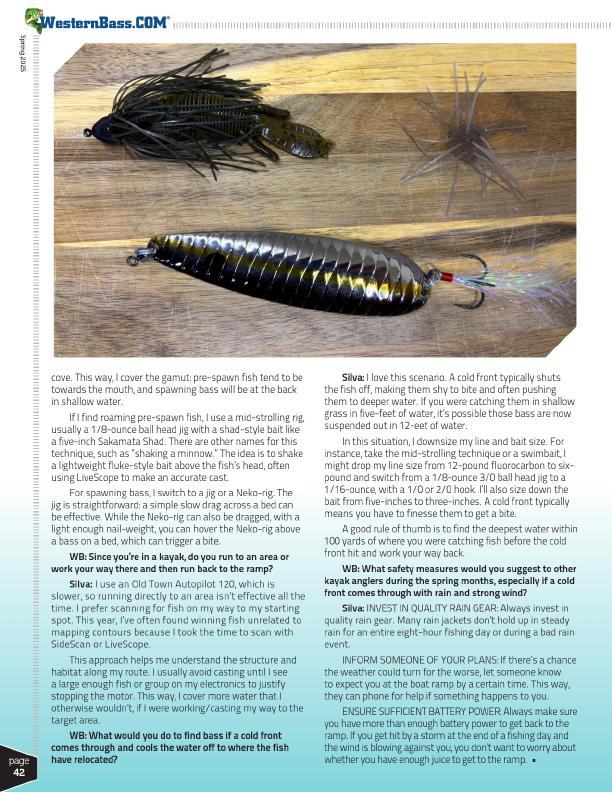
If I find roaming pre-spawn fish, I use a mid-strolling rig, usually a 1/8-ounce ball head jig with a shad-style bait like a five-inch Sakamata Shad. There are other names for this technique, such as “shaking a minnow.” The idea is to shake a lightweight fluke-style bait above the fish’s head, often using LiveScope to make an accurate cast.
For spawning bass, I switch to a jig or a Neko-rig. The jig is straightforward: a simple slow drag across a bed can be effective. While the Neko-rig can also be dragged, with a light enough nail-weight, you can hover the Neko-rig above a bass on a bed, which can trigger a bite.
WB: Since you’re in a kayak, do you run to an area or work your way there and then run back to the ramp?
Silva: I use an Old Town Autopilot 120, which is slower, so running directly to an area isn’t effective all the time. I prefer scanning for fish on my way to my starting spot. This year, I’ve often found winning fish unrelated to mapping contours because I took the time to scan with SideScan or LiveScope.
This approach helps me understand the structure and habitat along my route. I usually avoid casting until I see a large enough fish or group on my electronics to justify stopping the motor. This way, I cover more water that I otherwise wouldn’t, if I were working/casting my way to the target area.
WB: What would you do to find bass if a cold front comes through and cools the water off to where the fish have relocated?
Silva: I love this scenario. A cold front typically shuts the fish off, making them shy to bite and often pushing them to deeper water. If you were catching them in shallow grass in five-feet of water, it’s possible those bass are now suspended out in 12-eet of water.
In this situation, I downsize my line and bait size. For instance, take the mid-strolling technique or a swimbait, I might drop my line size from 12-pound fluorocarbon to six- pound and switch from a 1/8-ounce 3/0 ball head jig to a 1/16-ounce, with a 1/0 or 2/0 hook. I’ll also size down the bait from five-inches to three-inches. A cold front typically means you have to finesse them to get a bite.
A good rule of thumb is to find the deepest water within 100 yards of where you were catching fish before the cold front hit and work your way back.
WB: What safety measures would you suggest to other kayak anglers during the spring months, especially if a cold front comes through with rain and strong wind?
Silva: INVEST IN QUALITY RAIN GEAR: Always invest in quality rain gear. Many rain jackets don’t hold up in steady rain for an entire eight-hour fishing day or during a bad rain event.
INFORM SOMEONE OF YOUR PLANS: If there’s a chance the weather could turn for the worse, let someone know to expect you at the boat ramp by a certain time. This way, they can phone for help if something happens to you.
ENSURE SUFFICIENT BATTERY POWER: Always make sure you have more than enough battery power to get back to the ramp. If you get hit by a storm at the end of a fishing day and the wind is blowing against you, you don’t want to worry about whether you have enough juice to get to the ramp. •