®
Fall 2026
page 38
an Owner hook and a 1/8-ounce cylinder weight with approximately eight inches between the hook and weight.
Magill cast it right against the vegetation into the shallows.
“The boat was in a foot and a half of water and I cast into six-inches on the edge of the hyacinth,” he said. “It just looked really good, and I thought this was it.”
Then he felt the nibble. After three hours without action, even that was welcome.
“It felt like a bluegill bite, and I was just happy to get bit again,” he said.
He let it eat. Then he set the hook, and the fish ripped drag.
Christian Magill
“The fish was so fat, but it was not very muscular like a Delta fish,” Magill said. “You know how the Delta ones, even if they’re skinny, their back is pretty thick? This was opposite, where its back was skinny and its gut was thick. The tail was kind of bloodied, but I didn’t think it was on a bed.”
The big bass fell to the Roboworm at approximately 4 p.m. The air temperature was 91 degrees. Was the double-digit simply nibbling at the finesse worm when Magill mistook the bite for a bluegill? Was it on a bed? Had it simply been tucked into absurdly shallow water, hidden against the hyacinth during one of the tougher periods of the day?
WHEN THE DRAG STARTED SCREAMING
The little bluegill-like tick had suddenly become something neither angler was prepared to see.
“We both freaked out and thought it was like 15 pounds,” said Magill.
Then the fish jumped, and both anglers got their first look at it simultaneously. The bass made its way behind the boat and came out of the water three times. Each jump offered another opportunity for the tiny dropshot hook to come loose. It didn’t.
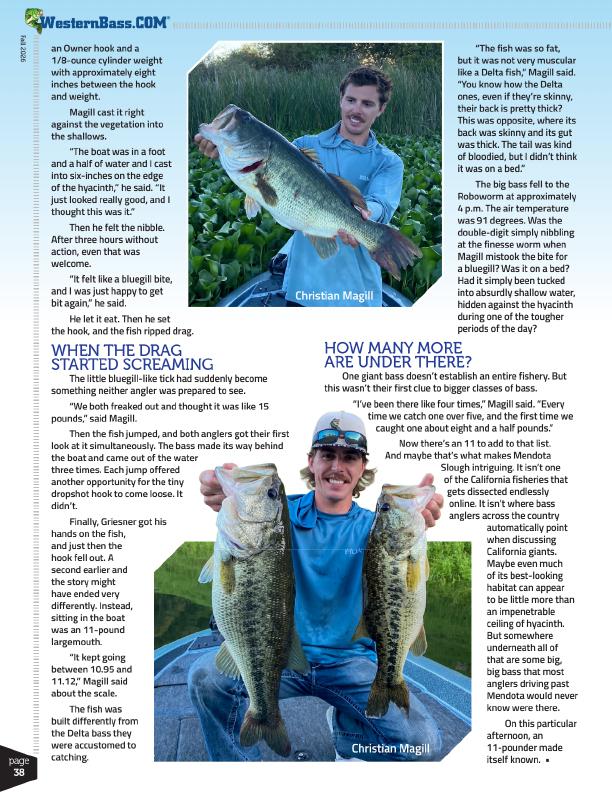
Finally, Griesner got his hands on the fish, and just then the hook fell out. A second earlier and the story might have ended very differently. Instead, sitting in the boat was an 11-pound largemouth.
“It kept going between 10.95 and 11.12,” Magill said about the scale.
The fish was built differently from the Delta bass they were accustomed to catching.
HOW MANY MORE ARE UNDER THERE?
One giant bass doesn’t establish an entire fishery. But this wasn’t their first clue to bigger classes of bass.
“I’ve been there like four times,” Magill said. “Every
time we catch one over five, and the first time we
caught one about eight and a half pounds.”
Now there’s an 11 to add to that list. And maybe that’s what makes Mendota
Slough intriguing. It isn’t one
of the California fisheries that
gets dissected endlessly
online. It isn’t where bass
anglers across the country
automatically point
when discussing
California giants.
Maybe even much
of its best-looking
habitat can appear
to be little more than
an impenetrable
ceiling of hyacinth.
But somewhere
underneath all of
that are some big,
big bass that most
anglers driving past
Mendota would never
know were there.
Christian Magill
On this particular afternoon, an 11-pounder made itself known. •