C
alifornia bass
anglers don’t
lack famous water. Clear Lake has a nearly
continuous draw of national
attention, especially when it
makes the Bassmaster List of
Best Lakes. The California Delta
has built its own reputation
as well as many anglers’
reputations over decades of
30-plus pound bags. Shasta
is synonymous with spotted
bass, and plenty of other
fisheries routinely enter
the conversation when big
California bass are the subject.
Over the years of talking with bass anglers, covering big bass stories, shooting pb pix, and covering tournaments, Mendota Slough had never come up in the convo. Recently, it did.
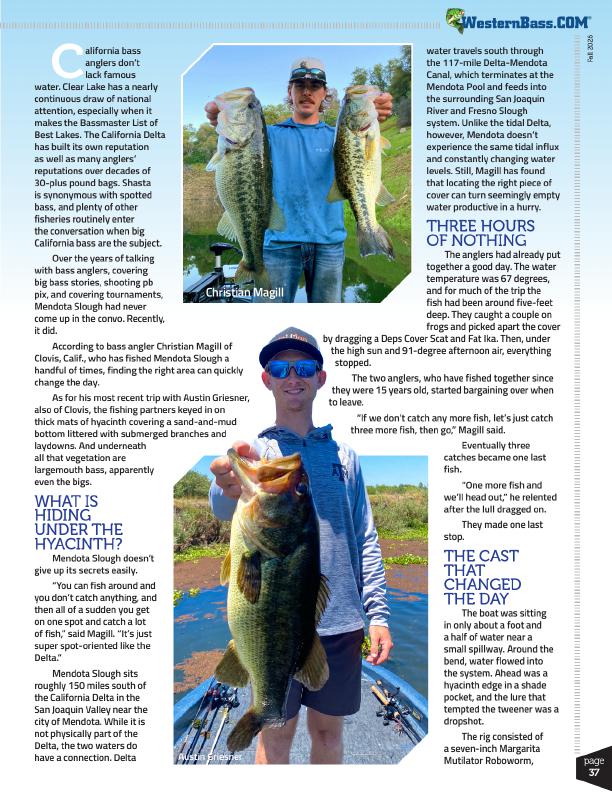
Christian Magill
According to bass angler Christian Magill of Clovis, Calif., who has fished Mendota Slough a handful of times, finding the right area can quickly change the day.
As for his most recent trip with Austin Griesner, also of Clovis, the fishing partners keyed in on thick mats of hyacinth covering a sand-and-mud bottom littered with submerged branches and laydowns. And underneath all that vegetation are largemouth bass, apparently even the bigs.
WHAT IS HIDING UNDER THE HYACINTH?
Mendota Slough doesn’t give up its secrets easily.
“You can fish around and you don’t catch anything, and then all of a sudden you get on one spot and catch a lot of fish,” said Magill. “It’s just super spot-oriented like the Delta.”
Mendota Slough sits roughly 150 miles south of the California Delta in the San Joaquin Valley near the city of Mendota. While it is not physically part of the Delta, the two waters do have a connection. Delta
Austin Griesner
®
water travels south through the 117-mile Delta-Mendota Canal, which terminates at the Mendota Pool and feeds into the surrounding San Joaquin River and Fresno Slough system. Unlike the tidal Delta, however, Mendota doesn’t experience the same tidal influx and constantly changing water levels. Still, Magill has found that locating the right piece of cover can turn seemingly empty water productive in a hurry.
THREE HOURS
OF NOTHING
The anglers had already put
together a good day. The water
temperature was 67 degrees,
and for much of the trip the
fish had been around five-feet
deep. They caught a couple on
frogs and picked apart the cover by dragging a Deps Cover Scat and Fat Ika. Then, under
the high sun and 91-degree afternoon air, everything
stopped.
The two anglers, who have fished together since they were 15 years old, started bargaining over when to leave.
“If we don’t catch any more fish, let’s just catch three more fish, then go,” Magill said.
Eventually three catches became one last fish.
“One more fish and we’ll head out,” he relented after the lull dragged on.
They made one last stop.
THE CAST THAT CHANGED THE DAY
The boat was sitting in only about a foot and a half of water near a small spillway. Around the bend, water flowed into the system. Ahead was a hyacinth edge in a shade pocket, and the lure that tempted the tweener was a dropshot.
The rig consisted of a seven-inch Margarita Mutilator Roboworm,
Fall 2026
page
37