Fall 2026
®
1STGEN
1STGEN
page 28
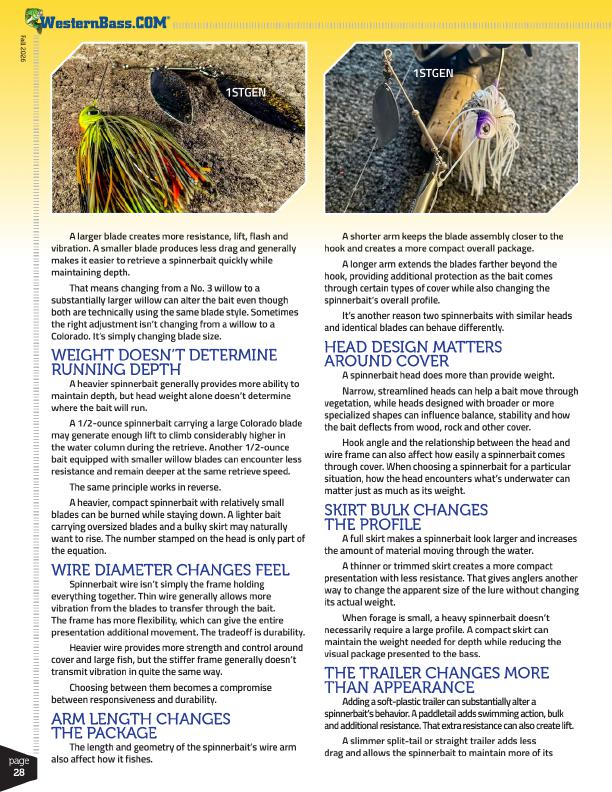
A larger blade creates more resistance, lift, flash and vibration. A smaller blade produces less drag and generally makes it easier to retrieve a spinnerbait quickly while maintaining depth.
That means changing from a No. 3 willow to a substantially larger willow can alter the bait even though both are technically using the same blade style. Sometimes the right adjustment isn’t changing from a willow to a Colorado. It’s simply changing blade size.
WEIGHT DOESN’T DETERMINE RUNNING DEPTH
A heavier spinnerbait generally provides more ability to maintain depth, but head weight alone doesn’t determine where the bait will run.
A 1/2-ounce spinnerbait carrying a large Colorado blade may generate enough lift to climb considerably higher in the water column during the retrieve. Another 1/2-ounce bait equipped with smaller willow blades can encounter less resistance and remain deeper at the same retrieve speed.
The same principle works in reverse.
A heavier, compact spinnerbait with relatively small blades can be burned while staying down. A lighter bait carrying oversized blades and a bulky skirt may naturally want to rise. The number stamped on the head is only part of the equation.
WIRE DIAMETER CHANGES FEEL
Spinnerbait wire isn’t simply the frame holding everything together. Thin wire generally allows more vibration from the blades to transfer through the bait. The frame has more flexibility, which can give the entire presentation additional movement. The tradeoff is durability.
Heavier wire provides more strength and control around cover and large fish, but the stiffer frame generally doesn’t transmit vibration in quite the same way.
Choosing between them becomes a compromise between responsiveness and durability.
ARM LENGTH CHANGES THE PACKAGE
The length and geometry of the spinnerbait’s wire arm also affect how it fishes.
A shorter arm keeps the blade assembly closer to the hook and creates a more compact overall package.
A longer arm extends the blades farther beyond the hook, providing additional protection as the bait comes through certain types of cover while also changing the spinnerbait’s overall profile.
It’s another reason two spinnerbaits with similar heads and identical blades can behave differently.
HEAD DESIGN MATTERS AROUND COVER
A spinnerbait head does more than provide weight.
Narrow, streamlined heads can help a bait move through vegetation, while heads designed with broader or more specialized shapes can influence balance, stability and how the bait deflects from wood, rock and other cover.
Hook angle and the relationship between the head and wire frame can also affect how easily a spinnerbait comes through cover. When choosing a spinnerbait for a particular situation, how the head encounters what’s underwater can matter just as much as its weight.
SKIRT BULK CHANGES THE PROFILE
A full skirt makes a spinnerbait look larger and increases the amount of material moving through the water.
A thinner or trimmed skirt creates a more compact presentation with less resistance. That gives anglers another way to change the apparent size of the lure without changing its actual weight.
When forage is small, a heavy spinnerbait doesn’t necessarily require a large profile. A compact skirt can maintain the weight needed for depth while reducing the visual package presented to the bass.
THE TRAILER CHANGES MORE THAN APPEARANCE
Adding a soft-plastic trailer can substantially alter a spinnerbait’s behavior. A paddletail adds swimming action, bulk and additional resistance. That extra resistance can also create lift.
A slimmer split-tail or straight trailer adds less drag and allows the spinnerbait to maintain more of its