®
Fall 2026
page 24
TABLE 1. SUMMARY OF BOATING INSPECTION REQUIREMENTS.
dynamic; boaters are encouraged to contact the managing agency to obtain current information
WATERWAY MAAGNEANGCINYG CURRENT REQUIREMENTS
on inspections or restrictions. A general summary is provided below for most popular Central and Northern California lakes and reservoirs. (Table 1).
Shasta Trinity
BOR/STNF BOR/STNF
Self Self
Refer to https://dbw.parks.ca.gov/?page_id=29367 for information and call the managing agency before you go. Table 1 provides a basic summary of
Whiskeytown
NPS
Self
requirements at time of preparation, however, as noted above the situation is dynamic and boaters
Lake Almanor
PG&E
Self
are urged to refer to the Department of Boating and
Lake Oroville
DWR
Self
Waterways and/or the managing agency.
Earlier this year, the California Department
Folsom
BOR 30-Day quarantine/banding
of Water Resources ended its invasive mussel
Clear Lake Lake County
Sticker/Inspection
inspection program at Lake Oroville, the Thermalito Forebay, and the Thermalito Afterbay on April 29,
Lake Berryessa
BOR 30-Day quarantine/banding
or Decon
2026, after a risk review found inspections no longer necessary.
Comanche
EBMUD
Closed
Golden mussels have not been detected at these facilities, and ongoing water testing and
New Hogan New Melones
ACOE BOR
Random Vessel Inspections
Banding Program
infrastructure inspections continue. As I had previously written, the literature did not fully support much of the concern and fortunately the
* Refer to https://dbw.parks.ca.gov/?page_id=29367 for information and call the managing agency before you go.
managing agencies have begun to realize this and begin to adaptively manage. Most Northern California reservoirs (Shasta, Trinity, Almanor,
etc.). The Whiskeytown-Shasta-Trinity Recreation
In July of this year, the California Department of Fish and Wildlife released their Invasive Mussel Control Plan. This plan is intended to provide guidance to public and private agencies that operate a water supply system where invasive mussels have been detected or developing an invasive mussel control plan. The development and implementation of the control plan is intended to contain invasive mussels within the water supply systems and maintain operation of the water supply system.
It is difficult to consolidate and synthesize the documented adverse economic and/or biological effects as it’s only been two-years since they were discovered, and it often takes the State several years to compile and publish any data.
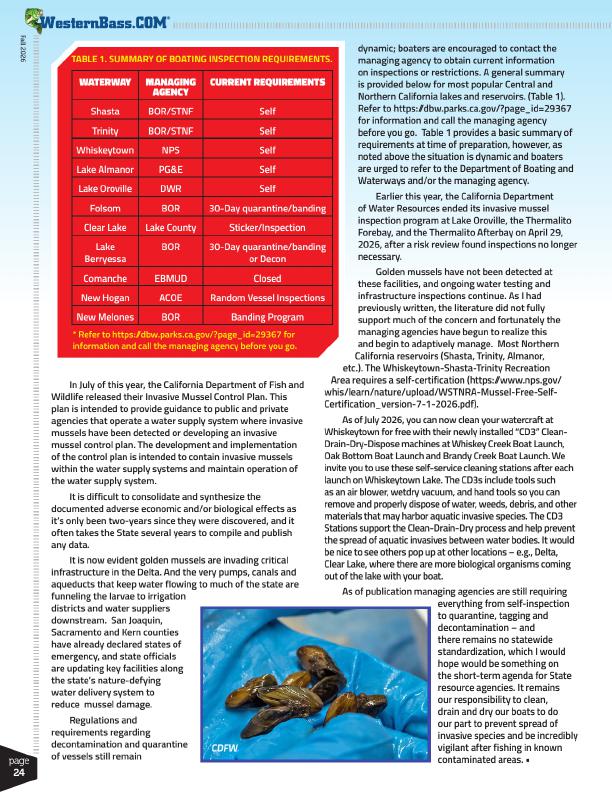
It is now evident golden mussels are invading critical infrastructure in the Delta. And the very pumps, canals and aqueducts that keep water flowing to much of the state are funneling the larvae to irrigation districts and water suppliers downstream. San Joaquin, Sacramento and Kern counties have already declared states of emergency, and state officials are updating key facilities along the state’s nature-defying water delivery system to reduce mussel damage.
Regulations and requirements regarding decontamination and quarantine of vessels still remain
CDFW
Area requires a self-certification (https://www.nps.gov/ whis/learn/nature/upload/WSTNRA-Mussel-Free-Self- Certification_version-7-1-2026.pdf).
As of July 2026, you can now clean your watercraft at Whiskeytown for free with their newly installed “CD3” Clean- Drain-Dry-Dispose machines at Whiskey Creek Boat Launch, Oak Bottom Boat Launch and Brandy Creek Boat Launch. We invite you to use these self-service cleaning stations after each launch on Whiskeytown Lake. The CD3s include tools such as an air blower, wetdry vacuum, and hand tools so you can remove and properly dispose of water, weeds, debris, and other materials that may harbor aquatic invasive species. The CD3 Stations support the Clean-Drain-Dry process and help prevent the spread of aquatic invasives between water bodies. It would be nice to see others pop up at other locations – e.g., Delta, Clear Lake, where there are more biological organisms coming out of the lake with your boat.
As of publication managing agencies are still requiring
everything from self-inspection
to quarantine, tagging and
decontamination – and
there remains no statewide
standardization, which I would
hope would be something on
the short-term agenda for State
resource agencies. It remains
our responsibility to clean,
drain and dry our boats to do
our part to prevent spread of
invasive species and be incredibly
vigilant after fishing in known
contaminated areas. •