Fall 2026
®
SOFT BAITS LOOK LIKE THE MEAL
A seven-inch soft bait approaches the same problem differently. Instead of relying as heavily on exaggerated movement and visual drawing power, a soft bait can present the profile of one substantial baitfish moving through the area. A soft bait can be slow-rolled through the water column, crawled along the bottom, skipped around docks or worked through grass and wood where a treble-hooked hard bait becomes difficult to fish.
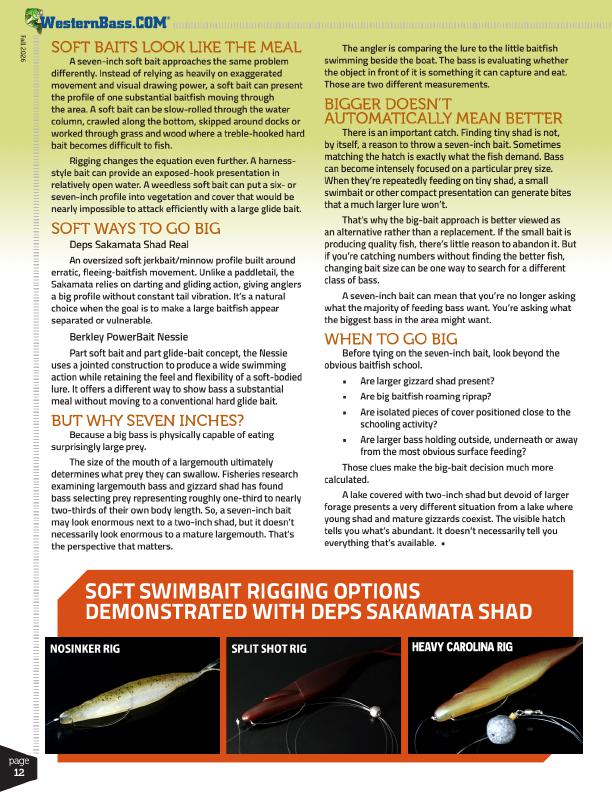
Rigging changes the equation even further. A harness- style bait can provide an exposed-hook presentation in relatively open water. A weedless soft bait can put a six- or seven-inch profile into vegetation and cover that would be nearly impossible to attack efficiently with a large glide bait.
SOFT WAYS TO GO BIG
Deps Sakamata Shad Real
An oversized soft jerkbait/minnow profile built around erratic, fleeing-baitfish movement. Unlike a paddletail, the Sakamata relies on darting and gliding action, giving anglers a big profile without constant tail vibration. It’s a natural choice when the goal is to make a large baitfish appear separated or vulnerable.
Berkley PowerBait Nessie
Part soft bait and part glide-bait concept, the Nessie uses a jointed construction to produce a wide swimming action while retaining the feel and flexibility of a soft-bodied lure. It offers a different way to show bass a substantial meal without moving to a conventional hard glide bait.
BUT WHY SEVEN INCHES?
Because a big bass is physically capable of eating surprisingly large prey.
The size of the mouth of a largemouth ultimately determines what prey they can swallow. Fisheries research examining largemouth bass and gizzard shad has found bass selecting prey representing roughly one-third to nearly two-thirds of their own body length. So, a seven-inch bait may look enormous next to a two-inch shad, but it doesn’t necessarily look enormous to a mature largemouth. That’s the perspective that matters.
The angler is comparing the lure to the little baitfish swimming beside the boat. The bass is evaluating whether the object in front of it is something it can capture and eat. Those are two different measurements.
BIGGER DOESN’T AUTOMATICALLY MEAN BETTER
There is an important catch. Finding tiny shad is not, by itself, a reason to throw a seven-inch bait. Sometimes matching the hatch is exactly what the fish demand. Bass can become intensely focused on a particular prey size. When they’re repeatedly feeding on tiny shad, a small swimbait or other compact presentation can generate bites that a much larger lure won’t.
That’s why the big-bait approach is better viewed as an alternative rather than a replacement. If the small bait is producing quality fish, there’s little reason to abandon it. But if you’re catching numbers without finding the better fish, changing bait size can be one way to search for a different class of bass.
A seven-inch bait can mean that you’re no longer asking what the majority of feeding bass want. You’re asking what the biggest bass in the area might want.
WHEN TO GO BIG
Before tying on the seven-inch bait, look beyond the obvious baitfish school.
• Are larger gizzard shad present?
• Are big baitfish roaming riprap?
• Are isolated pieces of cover positioned close to the
schooling activity?
• Are larger bass holding outside, underneath or away
from the most obvious surface feeding?
Those clues make the big-bait decision much more calculated.
A lake covered with two-inch shad but devoid of larger forage presents a very different situation from a lake where young shad and mature gizzards coexist. The visible hatch tells you what’s abundant. It doesn’t necessarily tell you everything that’s available. •
DSOEMFTOSNWSITMRABTAEITDRWIGITGHINDGEOPPSTSIAOKNASMATA SHAD
page
12