®
F
all bass fishing comes
with one of the oldest
rules in the book: match the hatch. The theory is simple:
when bass are blowing up on two-
inch shad, throw something that
looks like a two-inch shad. Small
swimbaits, compact crankbaits,
jerkbaits and other small baitfish
imitators have caught enough fall
bass to prove the theory works.
But matching the hatch isn’t the
only way to approach a fall feeding
frenzy.
While bass are tearing through thousands of tiny shad, there may be another opportunity swimming through the same water. And it raises a question that seems to contradict at least some of what anglers have been taught about fall fishing.
When the baitfish are so thick in the water you can walk across them, why would a bass eat a seven-inch bait? The answer runs contrary to the match-the- hatch theory. In fact, it’s the polar opposite. The seven-incher isn’t trying to mimic those two- inch baitfish. It’s giving the bass something totally different.
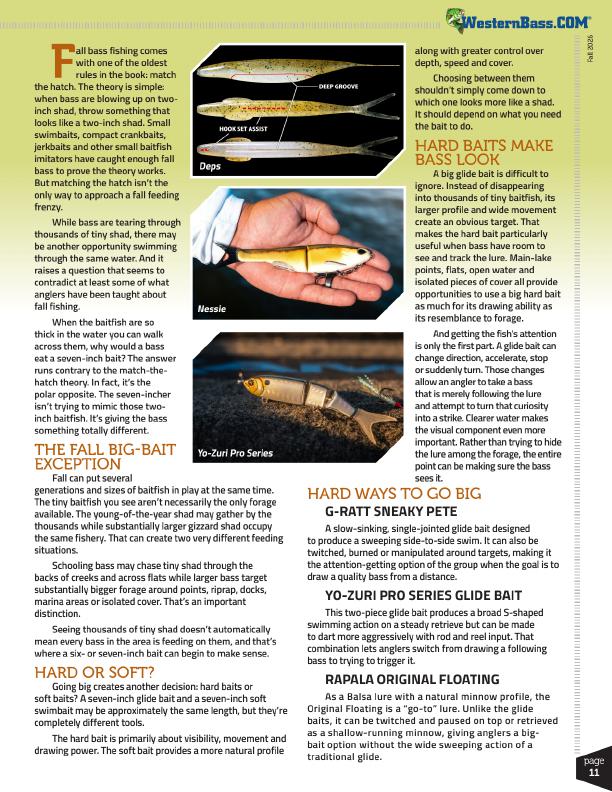
Deps Nessie
THE FALL BIG-BAIT Yo-Zuri Pro Series EXCEPTION
Fall can put several generations and sizes of baitfish in play at the same time. The tiny baitfish you see aren’t necessarily the only forage available. The young-of-the-year shad may gather by the thousands while substantially larger gizzard shad occupy the same fishery. That can create two very different feeding situations.
Schooling bass may chase tiny shad through the backs of creeks and across flats while larger bass target substantially bigger forage around points, riprap, docks, marina areas or isolated cover. That’s an important distinction.
Seeing thousands of tiny shad doesn’t automatically mean every bass in the area is feeding on them, and that’s where a six- or seven-inch bait can begin to make sense.
HARD OR SOFT?
Going big creates another decision: hard baits or soft baits? A seven-inch glide bait and a seven-inch soft swimbait may be approximately the same length, but they’re completely different tools.
The hard bait is primarily about visibility, movement and drawing power. The soft bait provides a more natural profile
along with greater control over depth, speed and cover.
Choosing between them shouldn’t simply come down to which one looks more like a shad. It should depend on what you need the bait to do.
HARD BAITS MAKE BASS LOOK
A big glide bait is difficult to ignore. Instead of disappearing into thousands of tiny baitfish, its larger profile and wide movement create an obvious target. That makes the hard bait particularly useful when bass have room to see and track the lure. Main-lake points, flats, open water and isolated pieces of cover all provide opportunities to use a big hard bait as much for its drawing ability as its resemblance to forage.
And getting the fish’s attention is only the first part. A glide bait can change direction, accelerate, stop or suddenly turn. Those changes allow an angler to take a bass that is merely following the lure and attempt to turn that curiosity into a strike. Clearer water makes the visual component even more important. Rather than trying to hide the lure among the forage, the entire point can be making sure the bass sees it.
HARD WAYS TO GO BIG
G-RATT SNEAKY PETE
A slow-sinking, single-jointed glide bait designed to produce a sweeping side-to-side swim. It can also be twitched, burned or manipulated around targets, making it the attention-getting option of the group when the goal is to draw a quality bass from a distance.
YO-ZURI PRO SERIES GLIDE BAIT
This two-piece glide bait produces a broad S-shaped swimming action on a steady retrieve but can be made to dart more aggressively with rod and reel input. That combination lets anglers switch from drawing a following bass to trying to trigger it.
RAPALA ORIGINAL FLOATING
As a Balsa lure with a natural minnow profile, the Original Floating is a “go-to” lure. Unlike the glide baits, it can be twitched and paused on top or retrieved as a shallow-running minnow, giving anglers a big- bait option without the wide sweeping action of a traditional glide.
Fall 2026
page
11