®
J
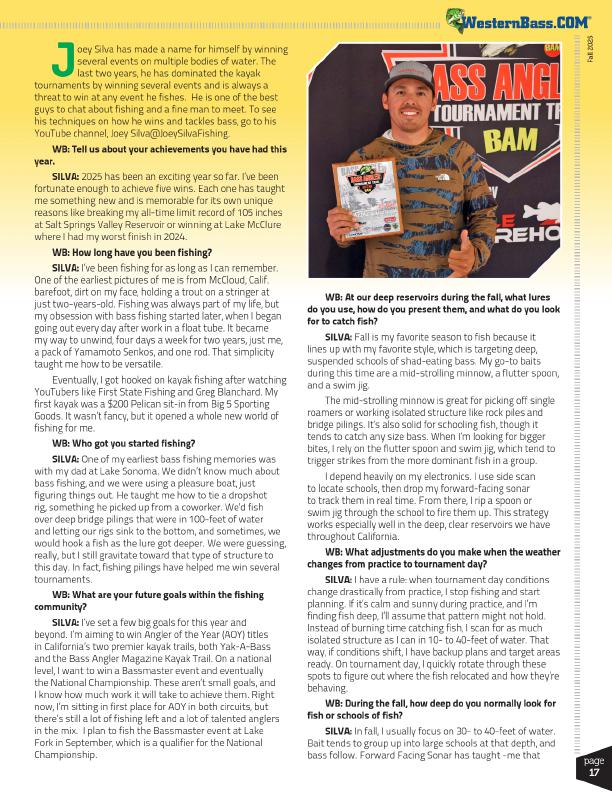
oey Silva has made a name for himself by winning
several events on multiple bodies of water. The
last two years, he has dominated the kayak tournaments by winning several events and is always a
threat to win at any event he fishes. He is one of the best
guys to chat about fishing and a fine man to meet. To see
his techniques on how he wins and tackles bass, go to his
YouTube channel, Joey Silva@JoeySilvaFishing.
WB: Tell us about your achievements you have had this year.
SILVA: 2025 has been an exciting year so far. I’ve been fortunate enough to achieve five wins. Each one has taught me something new and is memorable for its own unique reasons like breaking my all-time limit record of 105 inches at Salt Springs Valley Reservoir or winning at Lake McClure where I had my worst finish in 2024.
WB: How long have you been fishing?
SILVA: I’ve been fishing for as long as I can remember. One of the earliest pictures of me is from McCloud, Calif. barefoot, dirt on my face, holding a trout on a stringer at just two-years-old. Fishing was always part of my life, but my obsession with bass fishing started later, when I began going out every day after work in a float tube. It became my way to unwind, four days a week for two years, just me, a pack of Yamamoto Senkos, and one rod. That simplicity taught me how to be versatile.
Eventually, I got hooked on kayak fishing after watching YouTubers like First State Fishing and Greg Blanchard. My first kayak was a $200 Pelican sit-in from Big 5 Sporting Goods. It wasn’t fancy, but it opened a whole new world of fishing for me.
WB: Who got you started fishing?
SILVA: One of my earliest bass fishing memories was with my dad at Lake Sonoma. We didn’t know much about bass fishing, and we were using a pleasure boat, just figuring things out. He taught me how to tie a dropshot rig, something he picked up from a coworker. We’d fish over deep bridge pilings that were in 100-feet of water and letting our rigs sink to the bottom, and sometimes, we would hook a fish as the lure got deeper. We were guessing, really, but I still gravitate toward that type of structure to this day. In fact, fishing pilings have helped me win several tournaments.
WB: What are your future goals within the fishing community?
SILVA: I’ve set a few big goals for this year and beyond. I’m aiming to win Angler of the Year (AOY) titles in California’s two premier kayak trails, both Yak-A-Bass and the Bass Angler Magazine Kayak Trail. On a national level, I want to win a Bassmaster event and eventually the National Championship. These aren’t small goals, and I know how much work it will take to achieve them. Right now, I’m sitting in first place for AOY in both circuits, but there’s still a lot of fishing left and a lot of talented anglers in the mix. I plan to fish the Bassmaster event at Lake Fork in September, which is a qualifier for the National Championship.
WB: At our deep reservoirs during the fall, what lures do you use, how do you present them, and what do you look for to catch fish?
SILVA: Fall is my favorite season to fish because it lines up with my favorite style, which is targeting deep, suspended schools of shad-eating bass. My go-to baits during this time are a mid-strolling minnow, a flutter spoon, and a swim jig.
The mid-strolling minnow is great for picking off single roamers or working isolated structure like rock piles and bridge pilings. It’s also solid for schooling fish, though it tends to catch any size bass. When I’m looking for bigger bites, I rely on the flutter spoon and swim jig, which tend to trigger strikes from the more dominant fish in a group.
I depend heavily on my electronics. I use side scan to locate schools, then drop my forward-facing sonar to track them in real time. From there, I rip a spoon or swim jig through the school to fire them up. This strategy works especially well in the deep, clear reservoirs we have throughout California.
WB: What adjustments do you make when the weather changes from practice to tournament day?
SILVA: I have a rule: when tournament day conditions change drastically from practice, I stop fishing and start planning. If it’s calm and sunny during practice, and I’m finding fish deep, I’ll assume that pattern might not hold. Instead of burning time catching fish, I scan for as much isolated structure as I can in 10- to 40-feet of water. That way, if conditions shift, I have backup plans and target areas ready. On tournament day, I quickly rotate through these spots to figure out where the fish relocated and how they’re behaving.
WB: During the fall, how deep do you normally look for fish or schools of fish?
SILVA: In fall, I usually focus on 30- to 40-feet of water. Bait tends to group up into large schools at that depth, and bass follow. Forward Facing Sonar has taught -me that
Fall 2025
page
17