®
Winter 2026
MAXIMIZING TIME: THE IMPORTANCE OF KEEPING YOUR LURE IN THE WATER
Over the course of a fishing day, how much time is your lure out of the water? Every minute spent casting, reeling back to cast again, eating a sandwich, or moving between spots is wasted time not catching bass. If you want to catch more bass, keep your lure in the water.
THE ORIGINS OF STROLLING AND WIND-DRIVEN DRIFTING
A popular old-school technique to improve efficiency involves dragging your lure across the bottom for long distances. Drifting with the wind accomplishes this, but the problem with wind drifting is you go where the wind goes and at the speed of the wind. Astute anglers solve these problems by making small directional and speed corrections with the electric motor.
MODERN TROLLING MOTORS AND THE STROLLING TECHNIQUE
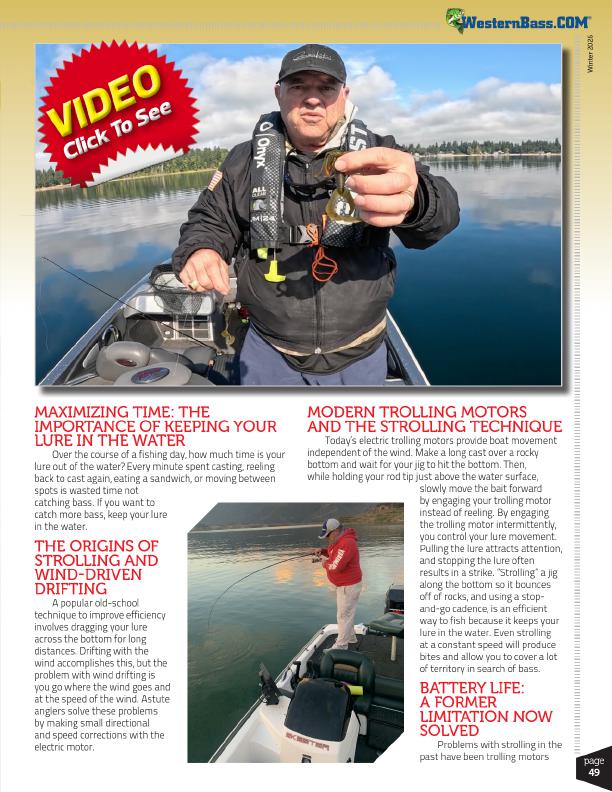
Today’s electric trolling motors provide boat movement independent of the wind. Make a long cast over a rocky bottom and wait for your jig to hit the bottom. Then, while holding your rod tip just above the water surface,
slowly move the bait forward
by engaging your trolling motor
instead of reeling. By engaging
the trolling motor intermittently,
you control your lure movement.
Pulling the lure attracts attention,
and stopping the lure often
results in a strike. “Strolling” a jig
along the bottom so it bounces
off of rocks, and using a stop-
and-go cadence, is an efficient
way to fish because it keeps your
lure in the water. Even strolling
at a constant speed will produce
bites and allow you to cover a lot
of territory in search of bass.
BATTERY LIFE: A FORMER LIMITATION NOW SOLVED
Problems with strolling in the past have been trolling motors
page 49