Winter 2026
page 46
®
Trey McKinneys and JT Thompkinses of the world pre- practice every event, they work on their game non-stop, and they don’t have significant obligations off the water that will prevent them from continuing to do so.
Just look at how the presumably “non-scoper” events played out this year:
• At Okeechobee, John Garrett was 2nd, Kyoya Fujita
was 3rd and McKinney was 8th;
• At the Sabine River, FFS OG Patrick Walters was the
runner-up, and Fujita and Taku Ito finished 3rd and
4th, respectively;
• At a flooded Tenkiller, McKinney was 6th and Taku Ito
was 12th; and
• At La Crosse, Jay Przekurat, Fujita and Tucker Smith
finished 5th, 6th and 7th, respectively.
And if you want to see how it’s played out in other venues, look to the Bass Pro Tour. Prior to their 2025 tour season, they put a different wrinkle on FFS strategy. Across all levels of MLF competition they limited the arms race, but on BPT, pros would only be allowed to use forward-facing and 360-degree sonar for one of the three competition periods each day. Anglers would be required to declare their use of the technologies before the start of the period of their choice.
SO HOW DID IT CHANGE THINGS?
Well, the 2024 AOY, world-beater Jacob Wheeler, repeated the title – his fourth time in five years. In total, six of the top-10 made the top-10 again. One of the other four was second place finisher Jake Lawrence, a newcomer to the tour.
The big risers were Ron Nelson, who went from 30th to 7th; Brent Ehlrler, who went from 18th to 9th; and Cole
Floyd, who went from 15th to 4th. Those, I submit, are just reasonable and predictable yearly fluctuations. It would be exceptionally hard to pin them on a change in the rules.
Of course, there’s a third tour out there, the NPFL, which prohibited the use of FFS in competition altogether. For that bold decision, they received plaudits from numerous opponents of the technology’s use. They also received buy- in from a number of Elite Series pros who elected to double dip by fishing two tours.
Patrick Walters, who’d threatened to win an Elite AOY but had consistently fallen a bit short, claimed the NPFL title. Even though he was one of the first to capitalize on FFS in a big way when he set a then-record margin of victory at Fork in 2020, this time he did it with dialed-back tech.
Second place went to Kyle Welcher, who had earned an Elite AOY in 2023, the heart of the FFS era. He used it even more creatively this year when he broke the margin-of- victory record in his Pasquotank River victory. It seems likely (although no one can be certain) that he still would have won comfortably without it.
Again, this is a small sample size, but I think it supports my general thesis that “catchers gonna catch.” It’s impossible to excel on any major tour simply by pinging a minnow.
On the NPFL side, my smidgen of doubt comes slightly further down the AOY list. The top-five were all Elite pros. So were 12 of the top 13. That includes old-school types like Greg Hackney, Jason Chrisitie, Hank Cherry and Gerald Swindle, all of whom had tough years at BASS. Certainly they haven’t forgotten how to catch fish. Did their success have something to do with the difference in the rules? Did it come down to differences in scheduling? Or was it a matter of attitude, as more than one of them had expressed dissatisfaction with the dominance of FFS?
There’s not enough data here to create a meaningful
basis for analytics,
but in the history of
bass fishing, there
have been few if any
rags-to-riches climbs
or top-to-bottom
plummets.
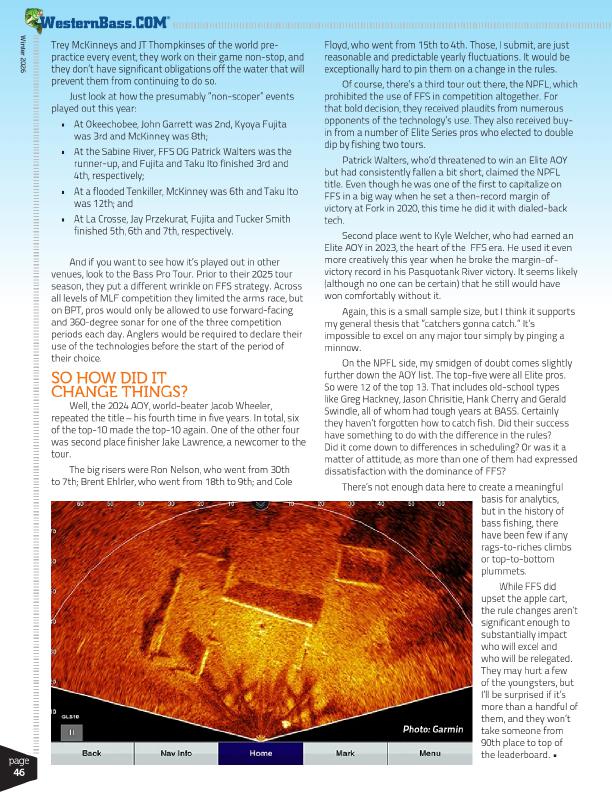
Photo: Garmin
While FFS did upset the apple cart, the rule changes aren’t significant enough to substantially impact who will excel and who will be relegated. They may hurt a few of the youngsters, but I’ll be surprised if it’s more than a handful of them, and they won’t take someone from 90th place to top of the leaderboard. •