LATE-SEASON DECISIONS
When the cold- water period hits your local waters, you may have a few decisions to make. Is it time to put the boat away for the season, or are you going to continue to fish and see what the bass have in store for you? For me, I will bleed every moment out of what the season will give me. I have many memories from this time of year, but you may have to make a few adjustments along the way to handle what Mother Nature has in store for you and what the bass can dish out. Let’s take a closer look at late-season bass fishing and set a few ground rules that you can follow and still get bass over the side of your boat.
KEEP BAIT CHOICES SIMPLE
When fishing late into the season, keep your bait choices simple. I will have a few deep-water crankbaits in my collection at arm’s length. My choices in this category are Rapala DT-10 & DT-16 and Strike King 3XD & 5XD crankbaits. Both crankbaits will cover the same depth, but their makeup is different to help you match your bait choice to the water conditions you are facing. The Rapala DT is a silent bait, while the XDs have rattles. I often will not try to guess what the bass want; instead, I give each of these baits time to let the bass show me what they choose.
Another bait that I carry is a stickbait. I use a SPRO McStick and rely on two sizes at this time of year—the regular McStick 110 and the 110+. I stock a few distinct colors to match the baitfish I am trying to imitate in the waters I am fishing. I will throw a stickbait if a bass won’t commit to a crankbait or as a follow-up bait to a missed strike.
The last—and most crucial—bait I use at this time of year is a jig. Once I get an idea of where the bass are located, I often lock a jig in my hand and go to work. Matching bite conditions becomes easy when you pay close attention to what the bass are telling you.
JIG BREAKDOWN
WEED JIGS
Depending on where I find bass, I lean on a few different jigs during the cold-water period. First up is a weed jig. Bass will spend a lot of time in the weeds, so you need a jig that can get through the weeds cleanly. I have never had a weed on my jig during my retrieve and still caught a bass. My number-one jig for this presentation is a bullet head. I
often build my own using a Do-It jig mold, which allows me to fine-tune my jigs and make choices that help me catch more bass.
I can select the
jig hook I want to
use and experiment
with different hook
sizes and styles. I
can also adjust weed
guards to better
match my jigs to the
weed conditions and
bite conditions I’m
facing throughout
the season. I make a
few jigs with heavy,
medium, and light
weed guards. With
these options, I can quickly adjust my jig to the conditions on the water that day or change setups if the bite changes or I move to a different type of cover.
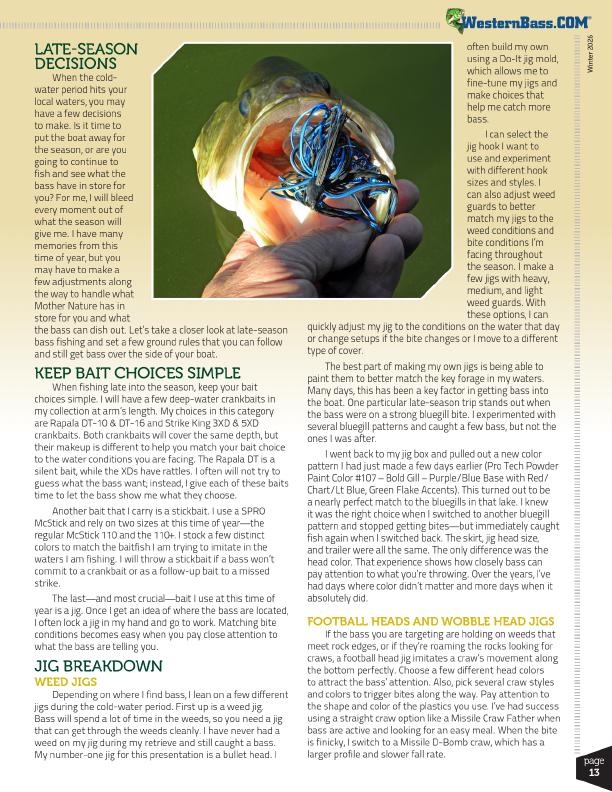
The best part of making my own jigs is being able to paint them to better match the key forage in my waters. Many days, this has been a key factor in getting bass into the boat. One particular late-season trip stands out when the bass were on a strong bluegill bite. I experimented with several bluegill patterns and caught a few bass, but not the ones I was after.
I went back to my jig box and pulled out a new color pattern I had just made a few days earlier (Pro Tech Powder Paint Color #107 – Bold Gill – Purple/Blue Base with Red/ Chart/Lt Blue, Green Flake Accents). This turned out to be a nearly perfect match to the bluegills in that lake. I knew it was the right choice when I switched to another bluegill pattern and stopped getting bites—but immediately caught fish again when I switched back. The skirt, jig head size, and trailer were all the same. The only difference was the head color. That experience shows how closely bass can pay attention to what you’re throwing. Over the years, I’ve had days where color didn’t matter and more days when it absolutely did.
FOOTBALL HEADS AND WOBBLE HEAD JIGS
If the bass you are targeting are holding on weeds that meet rock edges, or if they’re roaming the rocks looking for craws, a football head jig imitates a craw’s movement along the bottom perfectly. Choose a few different head colors to attract the bass’ attention. Also, pick several craw styles and colors to trigger bites along the way. Pay attention to the shape and color of the plastics you use. I’ve had success using a straight craw option like a Missile Craw Father when bass are active and looking for an easy meal. When the bite is finicky, I switch to a Missile D-Bomb craw, which has a larger profile and slower fall rate.
®
Winter 2026
page
13