Spring 2025
page 56
®
largemouth on a nightcrawler, California’s first bass over twenty-pounds.
After graduating from college in1975 and having competed that year in the BASS Federation Nationals, I entered active duty in the military. After a tour in Germany, I was stationed in California, which is how David Zimmerlee came to San Diego. Towing my MonArk bass boat across the country the first lake I fished was, of course, Lake Miramar. I didn’t land Mama Pesce, but my quest began (along with my understanding of the need to use light line).
SO, WHAT MADE SAN DIEGO FLORIDA-STRAIN BASS GROW SO FAST AND BIG?
We may never know all the factors, but several are apparent. As previously stated, pure Florida-strain bass are inherently harder to catch than northern-strain. This trait is somewhat diluted once they crossbreed with northern- strain bass. Their offspring are called F1 hybrids. It turns out these hybrids gain the best traits of both northern and Florida-strain parents. They grow even larger and faster than pure Florida-strain bass and live longer and bite better. The F1 hybrids can grow to 2-pounds in their first year! Unfortunately, as subsequent generations are produced these traits continue to change and explains why over time we are seeing less monster bass.
The other important role in producing monster bass is the availability of high protein prey. Many western impoundments are low in fertility which explains the clear water. This reduces the natural availability of nutritious prey. Enter the stocking of hatchery trout. Combine this highly nutritious prey in clear water where they cannot hide from Florida- strain bass that hybridize with northern-strain bass, and you have a monster bass explosion.
As Florida-strain bass were introduced north of San Diego the monster bass trend moved to Lake Casitas, Castaic Lake, Lake Isabella, and from there the Sacramento Delta, Clear Lake and others.
TWENTY- POUND CLASS LARGEMOUTH AND OTHER BESTS
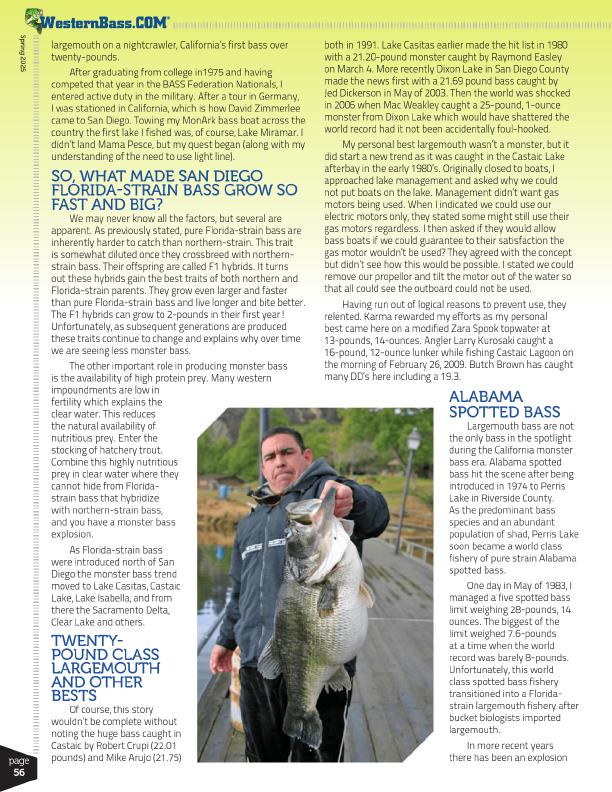
Of course, this story wouldn’t be complete without noting the huge bass caught in Castaic by Robert Crupi (22.01 pounds) and Mike Arujo (21.75)
both in 1991. Lake Casitas earlier made the hit list in 1980 with a 21.20-pound monster caught by Raymond Easley on March 4. More recently Dixon Lake in San Diego County made the news first with a 21.69 pound bass caught by Jed Dickerson in May of 2003. Then the world was shocked in 2006 when Mac Weakley caught a 25-pound, 1-ounce monster from Dixon Lake which would have shattered the world record had it not been accidentally foul-hooked.
My personal best largemouth wasn’t a monster, but it did start a new trend as it was caught in the Castaic Lake afterbay in the early 1980’s. Originally closed to boats, I approached lake management and asked why we could not put boats on the lake. Management didn’t want gas motors being used. When I indicated we could use our electric motors only, they stated some might still use their gas motors regardless. I then asked if they would allow bass boats if we could guarantee to their satisfaction the gas motor wouldn’t be used? They agreed with the concept but didn’t see how this would be possible. I stated we could remove our propellor and tilt the motor out of the water so that all could see the outboard could not be used.
Having run out of logical reasons to prevent use, they relented. Karma rewarded my efforts as my personal best came here on a modified Zara Spook topwater at 13-pounds, 14-ounces. Angler Larry Kurosaki caught a 16-pound, 12-ounce lunker while fishing Castaic Lagoon on the morning of February 26, 2009. Butch Brown has caught many DD’s here including a 19.3.
ALABAMA SPOTTED BASS
Largemouth bass are not the only bass in the spotlight during the California monster bass era. Alabama spotted bass hit the scene after being introduced in 1974 to Perris Lake in Riverside County. As the predominant bass species and an abundant population of shad, Perris Lake soon became a world class fishery of pure strain Alabama spotted bass.
One day in May of 1983, I managed a five spotted bass limit weighing 28-pounds, 14 ounces. The biggest of the limit weighed 7.6-pounds at a time when the world record was barely 8-pounds. Unfortunately, this world class spotted bass fishery transitioned into a Florida- strain largemouth fishery after bucket biologists imported largemouth.
In more recent years there has been an explosion