®
O
riginally developed in Japan, Bait Finesse
System (BFS) has become increasingly popular
among bass anglers looking to fish smaller lures with baitcasting equipment.
While many anglers associate BFS with ultra-light tackle and tiny baits, the real appeal lies in presentation. In many situations, BFS isn’t simply about downsizing; it’s about matching available forage and presenting smaller offerings around specific targets with precision.
Whether skipping a compact swimbait beneath a dock, casting a small hard bait along riprap, or working a finesse minnow through suspended fish, BFS provides another option when bass are keyed on smaller forage or a more subtle presentation.
WHY FISH BFS?
One of the primary advantages of BFS is the ability to fish lightweight presentations accurately around cover. Smaller lures can be delivered quietly around docks, brush, riprap, and other high-percentage targets with minimal disturbance. BFS also excels in short-range casting situations where repeated, accurate presentations are required. By controlling the spool throughout the cast, anglers can place small lures into tight openings while maintaining the efficiency and familiarity of casting tackle.
For bass feeding on smaller forage, a downsized profile and quieter entry can sometimes produce bites that larger presentations fail to generate. BFS has also become increasingly popular for skipping lightweight presentations beneath docks, marinas, and other hard-to-reach cover.
THE ANATOMY OF A BFS SETUP
Understanding where BFS shines starts with understanding the equipment. Dedicated BFS rods and reels are designed to cast and control presentations that push the limits of conventional casting gear.
REEL: The reel is arguably the most important component of a BFS setup. While rods and line play important roles, the reel largely determines how effectively a system handles smaller lures and presentations.
What separates a BFS reel from a traditional baitcaster is the spool. BFS reels use lightweight, shallow spools with lower startup inertia, allowing them to begin rotating with less effort during the cast. That becomes important when fishing presentations that sit near the lower end of what conventional casting gear can comfortably handle.
Braking systems are equally important. Smaller lures generate less momentum during a cast,
At time of this writing, the Daiwa PX BF 70 Casting Reel is currently on sale at Fisherman’s Warehouse.
making spool control more critical. A well-designed BFS reel helps anglers manage those presentations more consistently while reducing the likelihood of overruns.
The Daiwa PX BF 70 was developed specifically for BFS applications and incorporates the shallow spool and braking characteristics that define modern BFS reels. Paired with the right rod, it is capable of handling many of the presentations commonly associated with bass-focused BFS fishing, including compact swimbaits, finesse minnows, Ned rigs, weightless plastics, and other smaller-profile offerings.
ROD: While the reel often gets most of the attention in a BFS setup, the rod plays an important role in casting performance and presentation control. A rod that is too powerful may struggle to load properly with smaller lures, reducing casting efficiency and accuracy.
Most BFS rods feature light to medium-light power ratings paired with fast actions and responsive tips. The softer upper section helps load the rod during the cast, while the lower section retains enough backbone for hooksets and fish control.
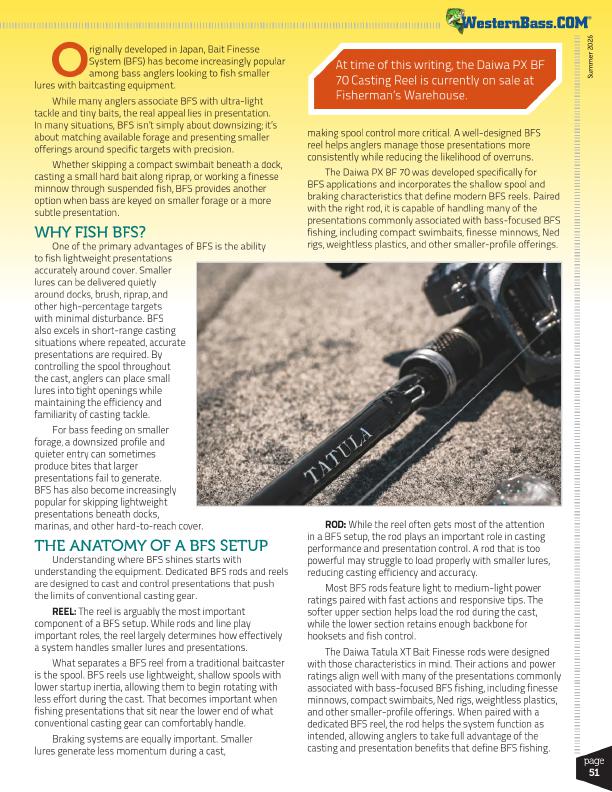
The Daiwa Tatula XT Bait Finesse rods were designed with those characteristics in mind. Their actions and power ratings align well with many of the presentations commonly associated with bass-focused BFS fishing, including finesse minnows, compact swimbaits, Ned rigs, weightless plastics, and other smaller-profile offerings. When paired with a dedicated BFS reel, the rod helps the system function as intended, allowing anglers to take full advantage of the casting and presentation benefits that define BFS fishing.
Summer 2026
page
51