®
Summer 2026
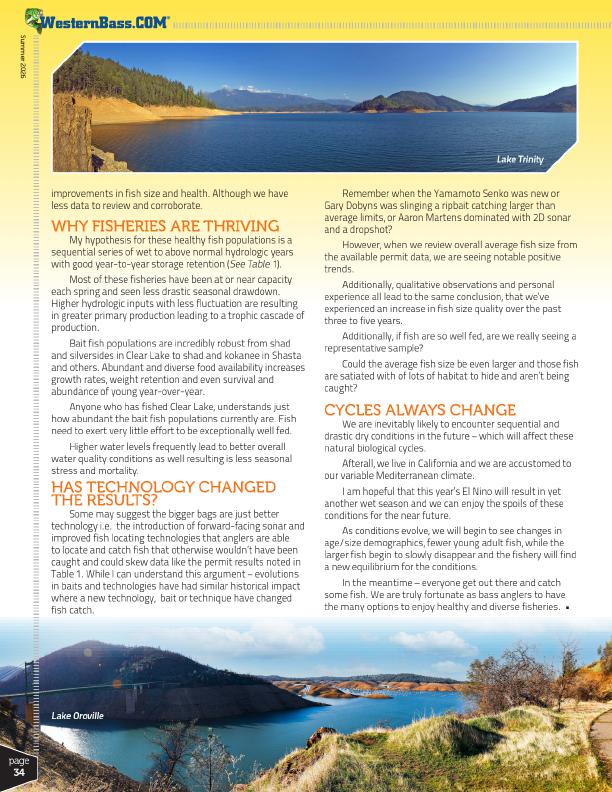
Lake Trinity
improvements in fish size and health. Although we have less data to review and corroborate.
WHY FISHERIES ARE THRIVING
My hypothesis for these healthy fish populations is a sequential series of wet to above normal hydrologic years with good year-to-year storage retention ( See Table 1 ).
Most of these fisheries have been at or near capacity each spring and seen less drastic seasonal drawdown. Higher hydrologic inputs with less fluctuation are resulting in greater primary production leading to a trophic cascade of production.
Bait fish populations are incredibly robust from shad and silversides in Clear Lake to shad and kokanee in Shasta and others. Abundant and diverse food availability increases growth rates, weight retention and even survival and abundance of young year-over-year.
Anyone who has fished Clear Lake, understands just how abundant the bait fish populations currently are. Fish need to exert very little effort to be exceptionally well fed.
Higher water levels frequently lead to better overall water quality conditions as well resulting is less seasonal stress and mortality.
HAS TECHNOLOGY CHANGED THE RESULTS?
Some may suggest the bigger bags are just better technology i.e. the introduction of forward-facing sonar and improved fish locating technologies that anglers are able to locate and catch fish that otherwise wouldn’t have been caught and could skew data like the permit results noted in Table 1. While I can understand this argument – evolutions in baits and technologies have had similar historical impact where a new technology, bait or technique have changed fish catch.
Remember when the Yamamoto Senko was new or Gary Dobyns was slinging a ripbait catching larger than average limits, or Aaron Martens dominated with 2D sonar and a dropshot?
However, when we review overall average fish size from the available permit data, we are seeing notable positive trends.
Additionally, qualitative observations and personal experience all lead to the same conclusion, that we’ve experienced an increase in fish size quality over the past three to five years.
Additionally, if fish are so well fed, are we really seeing a representative sample?
Could the average fish size be even larger and those fish are satiated with of lots of habitat to hide and aren’t being caught?
CYCLES ALWAYS CHANGE
We are inevitably likely to encounter sequential and drastic dry conditions in the future – which will affect these natural biological cycles.
Afterall, we live in California and we are accustomed to our variable Mediterranean climate.
I am hopeful that this year’s El Nino will result in yet another wet season and we can enjoy the spoils of these conditions for the near future.
As conditions evolve, we will begin to see changes in age/size demographics, fewer young adult fish, while the larger fish begin to slowly disappear and the fishery will find a new equilibrium for the conditions.
In the meantime – everyone get out there and catch some fish. We are truly fortunate as bass anglers to have the many options to enjoy healthy and diverse fisheries. •
Lake Oroville
page 34