O
ver the past several months, some of the strangest-looking bass lures in recent memory have flooded the market.
These “urchin baits,” as they are now called, are
everywhere you look, and there are many more on the way.
If you can get over the bizarre look of these baits and give
them a try, one of the first questions you will have is how to
rig them and how exactly you should fish them.
Since this is a new style of fishing, things are changing quickly, but no matter how you fish them, they are catching fish everywhere right now. Anglers are finding more and more ways to rig them and learning about situations where they work best. The results from weekend anglers to tournament pros have been fantastic with these baits, as they have accounted for several wins and top finishes in major tournaments.
MEET THE URCHINS
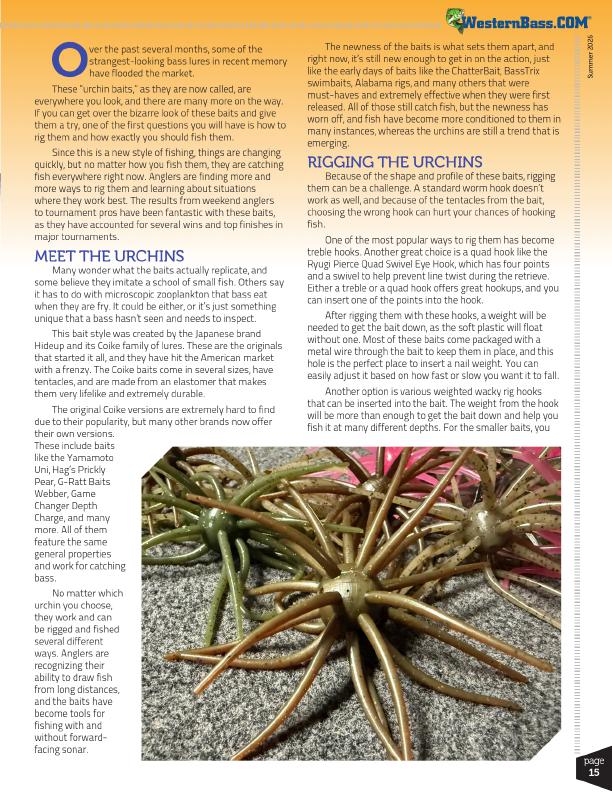
Many wonder what the baits actually replicate, and some believe they imitate a school of small fish. Others say it has to do with microscopic zooplankton that bass eat when they are fry. It could be either, or it’s just something unique that a bass hasn’t seen and needs to inspect.
This bait style was created by the Japanese brand Hideup and its Coike family of lures. These are the originals that started it all, and they have hit the American market with a frenzy. The Coike baits come in several sizes, have tentacles, and are made from an elastomer that makes them very lifelike and extremely durable.
The original Coike versions are extremely hard to find due to their popularity, but many other brands now offer their own versions. These include baits like the Yamamoto Uni, Hag’s Prickly Pear, G-Ratt Baits Webber, Game Changer Depth Charge, and many more. All of them feature the same general properties and work for catching bass.
No matter which urchin you choose, they work and can be rigged and fished several different ways. Anglers are recognizing their ability to draw fish from long distances, and the baits have become tools for fishing with and without forward- facing sonar.
The newness of the baits is what sets them apart, and right now, it’s still new enough to get in on the action, just like the early days of baits like the ChatterBait, BassTrix swimbaits, Alabama rigs, and many others that were must-haves and extremely effective when they were first released. All of those still catch fish, but the newness has worn off, and fish have become more conditioned to them in many instances, whereas the urchins are still a trend that is emerging.
RIGGING THE URCHINS
Because of the shape and profile of these baits, rigging them can be a challenge. A standard worm hook doesn’t work as well, and because of the tentacles from the bait, choosing the wrong hook can hurt your chances of hooking fish.
One of the most popular ways to rig them has become treble hooks. Another great choice is a quad hook like the Ryugi Pierce Quad Swivel Eye Hook, which has four points and a swivel to help prevent line twist during the retrieve. Either a treble or a quad hook offers great hookups, and you can insert one of the points into the hook.
After rigging them with these hooks, a weight will be needed to get the bait down, as the soft plastic will float without one. Most of these baits come packaged with a metal wire through the bait to keep them in place, and this hole is the perfect place to insert a nail weight. You can easily adjust it based on how fast or slow you want it to fall.
Another option is various weighted wacky rig hooks that can be inserted into the bait. The weight from the hook will be more than enough to get the bait down and help you fish it at many different depths. For the smaller baits, you
®
Summer 2026
page
15