Summer 2025
®
RIGGING DIFFERENCES: There are two different ways that you can rig your wacky- rig, and each way allows that soft plastic stickbait to fall differently in the water and have a different action to the bass. The first is to just put your hook directly through the soft plastic. This allows for a natural fall, but there is the potential that you are going to a lot of baits this way.
WACKY DEVICES: The next option is to use some type of wacky-rigging device, the benefit here is your bait will last a lot longer, so you’ll save money on baits, and valuable time on the water. There are two types of wacky-rigging options with “devices,” the first is using a rubber band, or plastic tube that goes around your bait and your hook will go between the plastic band, and the bait, an example of this would be the Arsenal Fishing Stealth Silicone Tube. The other type of “device” is a plastic spear that goes up through the bait, and then you put your hook through a small opening in the spear, like the JDM Geecrack Neko Hack.
PROFILE SIZE:
The common soft
plastic stickbait that
anglers use on their
wacky-rig, is five-
inches, so an easy
way to change up
your wacky-rigging
presentation is to
change the size
of your stickbait.
When the bite is
tough, if those bass
are pressured, or
you need to slide
your bait through a small opening under a boat dock, you can drop down to the four-inch size.
Or likewise if the bass wants a
bigger bait to key in on, or if the water
is stained, you can wacky-rig the
bigger six- or seven-inch soft plastic stickbaits. What is also nice about wacky-rigging these bigger baits is that they will fall faster in the water column is great than that of the five-inch bait, so sometimes it will help generate a reaction strike.
The next time you look at that wacky-rig you have rigged up, take the time to think about which of these variations in rigging you can use the next time you are on the water. •
page 64
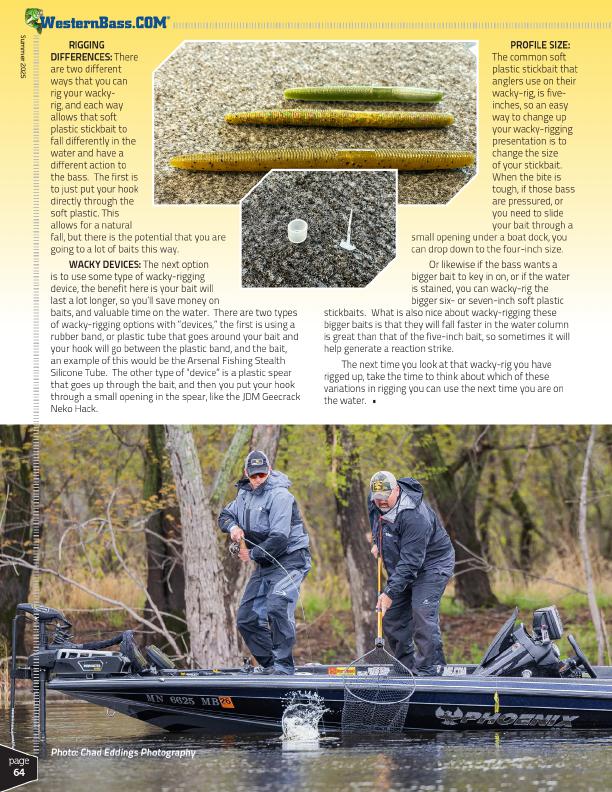
Photo: Chad Eddings Photography