Summer 2025
page 54
®
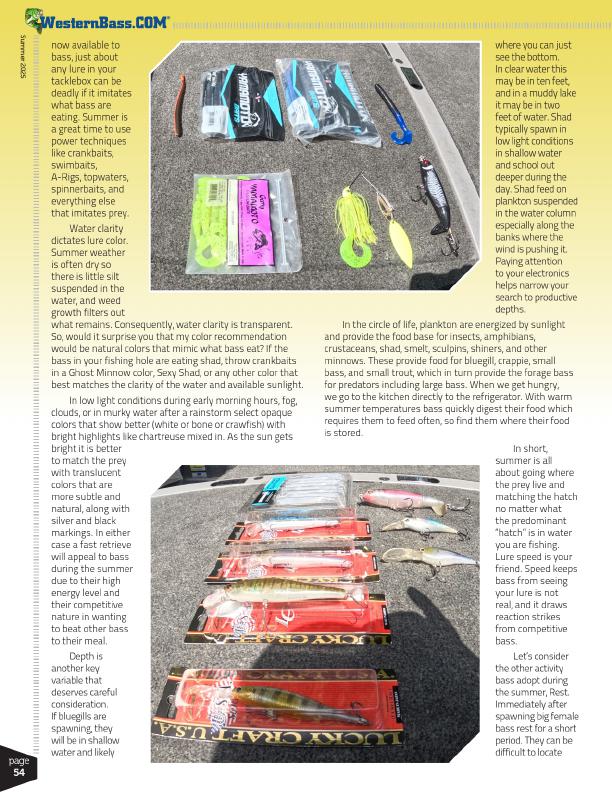
now available to bass, just about any lure in your tacklebox can be deadly if it imitates what bass are eating. Summer is a great time to use power techniques like crankbaits, swimbaits, A-Rigs, topwaters, spinnerbaits, and everything else that imitates prey.
Water clarity dictates lure color. Summer weather is often dry so there is little silt suspended in the water, and weed growth filters out what remains. Consequently, water clarity is transparent. So, would it surprise you that my color recommendation would be natural colors that mimic what bass eat? If the bass in your fishing hole are eating shad, throw crankbaits in a Ghost Minnow color, Sexy Shad, or any other color that best matches the clarity of the water and available sunlight.
In low light conditions during early morning hours, fog, clouds, or in murky water after a rainstorm select opaque colors that show better (white or bone or crawfish) with bright highlights like chartreuse mixed in. As the sun gets bright it is better to match the prey with translucent colors that are more subtle and natural, along with silver and black markings. In either case a fast retrieve will appeal to bass during the summer due to their high energy level and their competitive nature in wanting to beat other bass to their meal.
Depth is another key variable that deserves careful consideration. If bluegills are spawning, they will be in shallow water and likely
where you can just see the bottom. In clear water this may be in ten feet, and in a muddy lake it may be in two feet of water. Shad typically spawn in low light conditions in shallow water and school out deeper during the day. Shad feed on plankton suspended in the water column especially along the banks where the wind is pushing it. Paying attention to your electronics helps narrow your search to productive depths.
In the circle of life, plankton are energized by sunlight and provide the food base for insects, amphibians, crustaceans, shad, smelt, sculpins, shiners, and other minnows. These provide food for bluegill, crappie, small bass, and small trout, which in turn provide the forage bass for predators including large bass. When we get hungry, we go to the kitchen directly to the refrigerator. With warm summer temperatures bass quickly digest their food which requires them to feed often, so find them where their food is stored.
In short, summer is all about going where the prey live and matching the hatch no matter what the predominant “hatch” is in water you are fishing. Lure speed is your friend. Speed keeps bass from seeing your lure is not real, and it draws reaction strikes from competitive bass.
Let’s consider the other activity bass adopt during the summer, Rest. Immediately after spawning big female bass rest for a short period. They can be difficult to locate