A
s we all regrettably say goodbye to the beautiful
months of spring, we watch the lush green
hillsides turn to a crispy brown. We trade our sweatshirts and our shoes for sandals and shorts. Spring
is a comfortable and predictable season, where bass are
guaranteed to be near shallow water to spawn. Then once
the summer dog days of summer roll in, they will wander
into the cooler depth and be hard to catch.
OR WILL THEY?
Under many circumstances they will not. And, for those who can withstand the sweltering heat, there is a great opportunity to continue to catch fish, and sometimes some very big ones too.
For years we have been taught and learned that our best chance to catch fish during these hot summer months was either early morning or late evening. Avoiding the middle of the day heat was the only way to catch a lot of fish, and especially the biggest fish. These cooler temperatures, low light time frames can be very productive, but often not the best on hot summer days. In fact, our biggest summertime bags have come between 11:00 am and 4:00 pm, when the air temperatures are painfully hot and the sun is beating down.
SUMMER MISCONCEPTION
One of the biggest misconceptions made is bass become lethargic during the heat of summer. That they will retreat to deep/cooler water and the only way to catch them is with slower moving presentations. This can and will happen, but not always.
A bass is an opportunistic feeder. Which means they are not at all lethargic when the best time to feed is present. And they do not abandon shallow waters when their meal of choice resides there. Especially when their meal of choice has let down their guard. This happens when the smaller fish (prey) begin to feed. The focus becomes on feasting versus surviving. A perfect time for a larger patient fish to strike.
So, what are our best bait choices if we are not fishing slowly and on the bottom?
The answer is……Topwater!! This may sound crazy, but here is good reason why this is the most effective method.
Why we opt for a surface lure is that the smaller feeding fish are chasing bait near the surface. They have disregarded the big threat that lurks nearby and have become fixated on feeding their little bellies. An understanding of the food chain from bottom to top allows us to further grasp this concept.
It starts at the bottom of the food chain, plankton. These are tiny drifting organisms that are drawn to light. Which means they become condensed near the surface during the midday light exposure.
Then, what eats plankton? The answer is bass fry, sunfish fry, shad, and other fish as well, which forces this next level of the food chain up in the water column to feed on the plankton.
Next are the larger small fish. Just big enough to feed on the previous level. Consisting of a variety of sunfish including baby bass, bluegill, crappie and many more. This is
the level of the food chain which we are trying
to resemble and replicate. Finally, is the top,
the largest predator fish that prefer to
feed on the largest small fish, these are
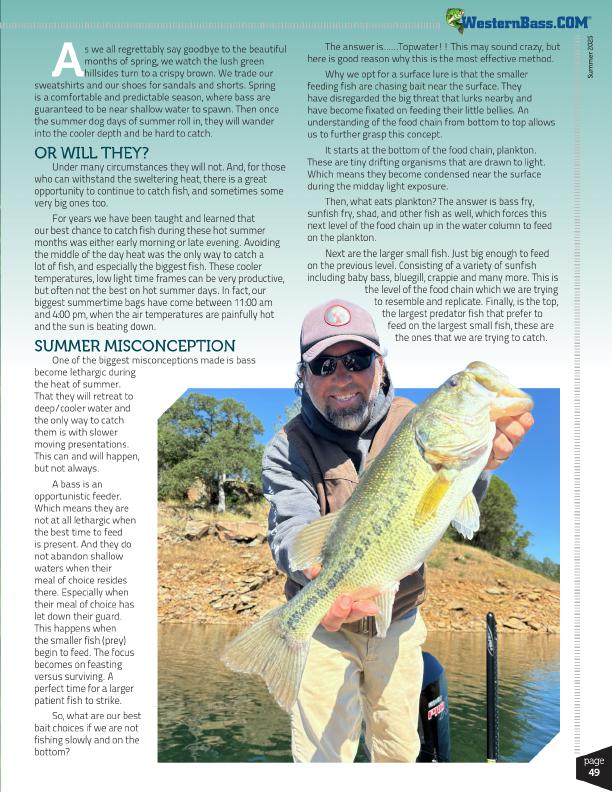
the ones that we are trying to catch.
®
Summer 2025
page 49