Summer 2025
T
here’s no doubt that forward-facing sonar, or
simply FFS, has changed bass fishing forever.
It’s created a firestorm in recent years, and anglers are usually either adamantly against it or all for
it. No matter where you stand on the topic, everyone can
agree that it has changed how anglers fish for bass.
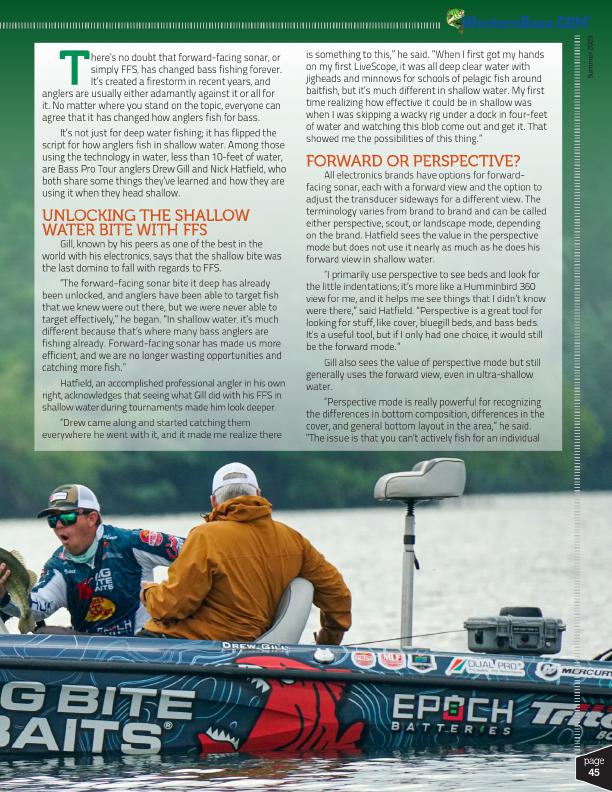
It’s not just for deep water fishing; it has flipped the script for how anglers fish in shallow water. Among those using the technology in water, less than 10-feet of water, are Bass Pro Tour anglers Drew Gill and Nick Hatfield, who both share some things they’ve learned and how they are using it when they head shallow.
UNLOCKING THE SHALLOW WATER BITE WITH FFS
Gill, known by his peers as one of the best in the world with his electronics, says that the shallow bite was the last domino to fall with regards to FFS.
“The forward-facing sonar bite it deep has already been unlocked, and anglers have been able to target fish that we knew were out there, but we were never able to target effectively,” he began. “In shallow water, it’s much different because that’s where many bass anglers are fishing already. Forward-facing sonar has made us more efficient, and we are no longer wasting opportunities and catching more fish.”
Hatfield, an accomplished professional angler in his own right, acknowledges that seeing what Gill did with his FFS in shallow water during tournaments made him look deeper.
“Drew came along and started catching them everywhere he went with it, and it made me realize there
is something to this,” he said. “When I first got my hands on my first LiveScope, it was all deep clear water with jigheads and minnows for schools of pelagic fish around baitfish, but it’s much different in shallow water. My first time realizing how effective it could be in shallow was when I was skipping a wacky rig under a dock in four-feet of water and watching this blob come out and get it. That showed me the possibilities of this thing.”
FORWARD OR PERSPECTIVE?
All electronics brands have options for forward- facing sonar, each with a forward view and the option to adjust the transducer sideways for a different view. The terminology varies from brand to brand and can be called either perspective, scout, or landscape mode, depending on the brand. Hatfield sees the value in the perspective mode but does not use it nearly as much as he does his forward view in shallow water.
“I primarily use perspective to see beds and look for the little indentations; it’s more like a Humminbird 360 view for me, and it helps me see things that I didn’t know were there,” said Hatfield. “Perspective is a great tool for looking for stuff, like cover, bluegill beds, and bass beds. It’s a useful tool, but if I only had one choice, it would still be the forward mode.”
Gill also sees the value of perspective mode but still generally uses the forward view, even in ultra-shallow water.
“Perspective mode is really powerful for recognizing the differences in bottom composition, differences in the cover, and general bottom layout in the area,” he said. “The issue is that you can’t actively fish for an individual
®
page 45