I
n the ever-evolving world of bass fishing, where
technology, trends, and tactics shift like wind on the
water, Japanese angler, Tatsuhiko Tsugaru stands firm—blade in hand, spinnerbait rigged, and fully committed
to throwing his favorite lure.
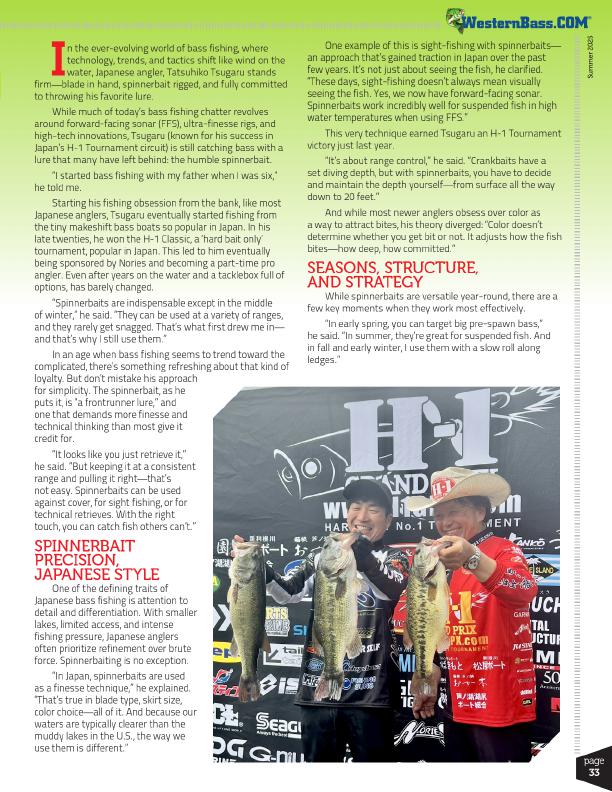
While much of today’s bass fishing chatter revolves around forward-facing sonar (FFS), ultra-finesse rigs, and high-tech innovations, Tsugaru (known for his success in Japan’s H-1 Tournament circuit) is still catching bass with a lure that many have left behind: the humble spinnerbait.
“I started bass fishing with my father when I was six,” he told me.
Starting his fishing obsession from the bank, like most Japanese anglers, Tsugaru eventually started fishing from the tiny makeshift bass boats so popular in Japan. In his late twenties, he won the H-1 Classic, a ‘hard bait only’ tournament, popular in Japan. This led to him eventually being sponsored by Nories and becoming a part-time pro angler. Even after years on the water and a tacklebox full of options, has barely changed.
“Spinnerbaits are indispensable except in the middle of winter,” he said. “They can be used at a variety of ranges, and they rarely get snagged. That’s what first drew me in— and that’s why I still use them.”
In an age when bass fishing seems to trend toward the complicated, there’s something refreshing about that kind of loyalty. But don’t mistake his approach for simplicity. The spinnerbait, as he puts it, is “a frontrunner lure,” and one that demands more finesse and technical thinking than most give it credit for.
“It looks like you just retrieve it,” he said. “But keeping it at a consistent range and pulling it right—that’s not easy. Spinnerbaits can be used against cover, for sight fishing, or for technical retrieves. With the right touch, you can catch fish others can’t.”
SPINNERBAIT PRECISION, JAPANESE STYLE
One of the defining traits of Japanese bass fishing is attention to detail and differentiation. With smaller lakes, limited access, and intense fishing pressure, Japanese anglers often prioritize refinement over brute force. Spinnerbaiting is no exception.
“In Japan, spinnerbaits are used as a finesse technique,” he explained. “That’s true in blade type, skirt size, color choice—all of it. And because our waters are typically clearer than the muddy lakes in the U.S., the way we use them is different.”
One example of this is sight-fishing with spinnerbaits— an approach that’s gained traction in Japan over the past few years. It’s not just about seeing the fish, he clarified. “These days, sight-fishing doesn’t always mean visually seeing the fish. Yes, we now have forward-facing sonar. Spinnerbaits work incredibly well for suspended fish in high water temperatures when using FFS.”
This very technique earned Tsugaru an H-1 Tournament victory just last year.
“It’s about range control,” he said. “Crankbaits have a set diving depth, but with spinnerbaits, you have to decide and maintain the depth yourself—from surface all the way down to 20 feet.”
And while most newer anglers obsess over color as a way to attract bites, his theory diverged: “Color doesn’t determine whether you get bit or not. It adjusts how the fish bites—how deep, how committed.”
SEASONS, STRUCTURE, AND STRATEGY
While spinnerbaits are versatile year-round, there are a few key moments when they work most effectively.
“In early spring, you can target big pre-spawn bass,” he said. “In summer, they’re great for suspended fish. And in fall and early winter, I use them with a slow roll along ledges.”
®
Summer 2025
page
33