®
E
arlier this year, before they’d been fully released,
swimbait guru Mike Bucca brought a handful of
2 1/2-inch and four-inch custom glide baits to a tackle show. He figured there was a legitimate chance he’d
be hauling them back to Georgia.
After all, for years we’ve bought into the concept that bigger is better in the glide game. Experts tell novice to upsize their lures. If you think a six is the only thing that’ll get followed or bit on your home lake, try a seven, or even an eight. The power of these lures is in their long-distance drawing power.
Accordingly, Bucca was surprised at the buzz the little lures caused. “I was offered a hundred dollars each for all of the little glide baits,” he recalled. “Guys saw my display baits and passed them around at the show. The response has been pretty wild.”
Veteran outdoor writer and tackle consultant Jason Sealock had a similar epiphany. He lives on Kentucky Lake and when the fishery was in great shape he observed that “bigger baits would always get more attention,” but as the lake’s bass population shifted he had to adjust with the times. The answer in many circumstances, was to go small.
“The idea is cool,” Sealock said of the smaller glide baits. “But they’re so light they’re hard to work correctly. That’s why I like the 4-inch York Nugget, which has a little more weight. That’s my go-to. The first time I fished it, alongside I dock, a 6-pounder came following it and I ended up hooking that fish on my very first cast. Then two or three years ago I took it out to fish brush piles in the fall. I caught seven fish, all 3-5 pounders. Then I caught nine fish from 4-7 pounds in an Arkansas pond just walking the bank. There’s just something about the way that the glide swims as compared to a jerkbait or small soft swimbait.”
WHEN WHERE AND HOW TO DOWNSIZE GLIDES
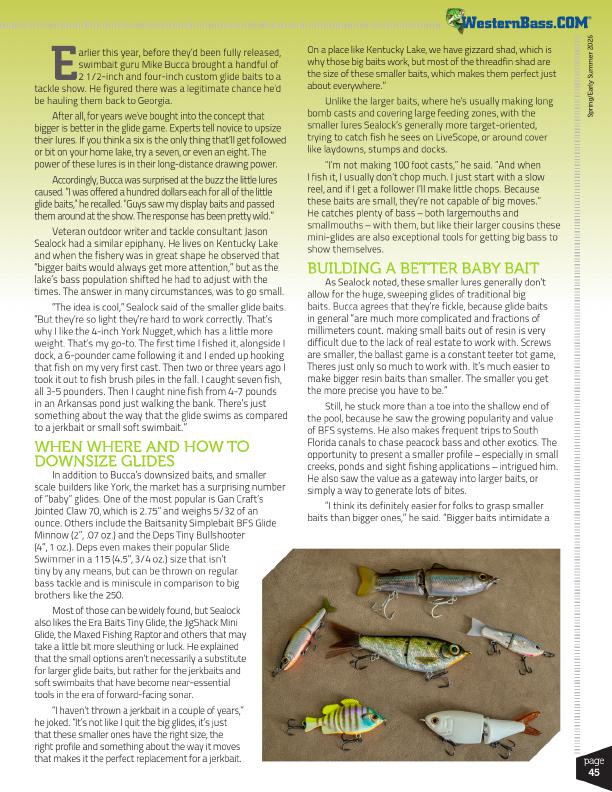
In addition to Bucca’s downsized baits, and smaller scale builders like York, the market has a surprising number of “baby” glides. One of the most popular is Gan Craft’s Jointed Claw 70, which is 2.75” and weighs 5/32 of an ounce. Others include the Baitsanity Simplebait BFS Glide Minnow (2”, .07 oz.) and the Deps Tiny Bullshooter (4”, 1 oz.). Deps even makes their popular Slide Swimmer in a 115 (4.5”, 3/4 oz.) size that isn’t tiny by any means, but can be thrown on regular bass tackle and is miniscule in comparison to big brothers like the 250.
Most of those can be widely found, but Sealock also likes the Era Baits Tiny Glide, the JigShack Mini Glide, the Maxed Fishing Raptor and others that may take a little bit more sleuthing or luck. He explained that the small options aren’t necessarily a substitute for larger glide baits, but rather for the jerkbaits and soft swimbaits that have become near-essential tools in the era of forward-facing sonar.
“I haven’t thrown a jerkbait in a couple of years,” he joked. “It’s not like I quit the big glides, it’s just that these smaller ones have the right size, the right profile and something about the way it moves that makes it the perfect replacement for a jerkbait.
On a place like Kentucky Lake, we have gizzard shad, which is why those big baits work, but most of the threadfin shad are the size of these smaller baits, which makes them perfect just about everywhere.”
Unlike the larger baits, where he’s usually making long bomb casts and covering large feeding zones, with the smaller lures Sealock’s generally more target-oriented, trying to catch fish he sees on LiveScope, or around cover like laydowns, stumps and docks.
“I’m not making 100 foot casts,” he said. “And when I fish it, I usually don’t chop much. I just start with a slow reel, and if I get a follower I’ll make little chops. Because these baits are small, they’re not capable of big moves.” He catches plenty of bass – both largemouths and smallmouths – with them, but like their larger cousins these mini-glides are also exceptional tools for getting big bass to show themselves.
BUILDING A BETTER BABY BAIT
As Sealock noted, these smaller lures generally don’t allow for the huge, sweeping glides of traditional big baits. Bucca agrees that they’re fickle, because glide baits in general “are much more complicated and fractions of millimeters count. making small baits out of resin is very difficult due to the lack of real estate to work with. Screws are smaller, the ballast game is a constant teeter tot game, Theres just only so much to work with. It’s much easier to make bigger resin baits than smaller. The smaller you get the more precise you have to be.“
Still, he stuck more than a toe into the shallow end of the pool, because he saw the growing popularity and value of BFS systems. He also makes frequent trips to South Florida canals to chase peacock bass and other exotics. The opportunity to present a smaller profile – especially in small creeks, ponds and sight fishing applications – intrigued him. He also saw the value as a gateway into larger baits, or simply a way to generate lots of bites.
“I think its definitely easier for folks to grasp smaller baits than bigger ones,” he said. “Bigger baits intimidate a
Spring/Early Summer 2026
page 45