F
ew bass fight harder pound-for-pound than a big
spotted bass. And when one pushes past the 6-
or 7-pound mark, landing it becomes a true trophy accomplishment.
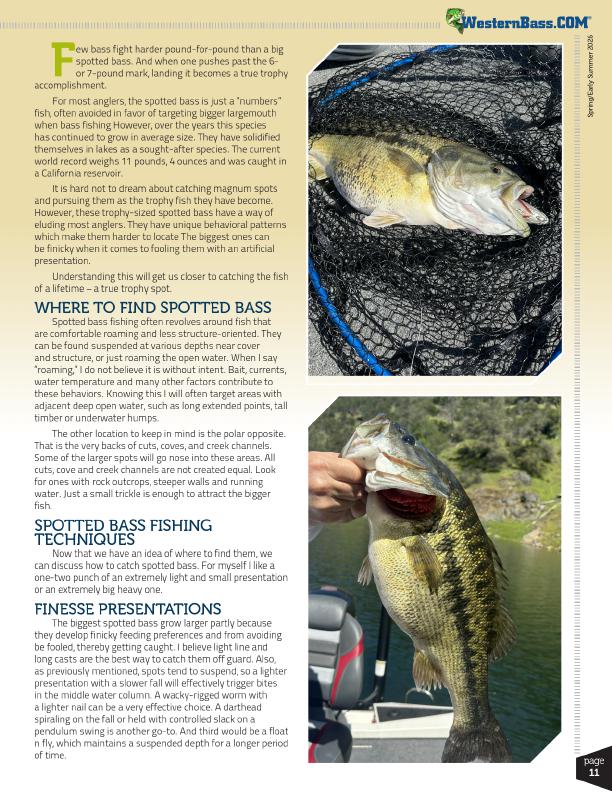
For most anglers, the spotted bass is just a “numbers” fish, often avoided in favor of targeting bigger largemouth when bass fishing However, over the years this species has continued to grow in average size. They have solidified themselves in lakes as a sought-after species. The current world record weighs 11 pounds, 4 ounces and was caught in a California reservoir.
It is hard not to dream about catching magnum spots and pursuing them as the trophy fish they have become. However, these trophy-sized spotted bass have a way of eluding most anglers. They have unique behavioral patterns which make them harder to locate The biggest ones can be finicky when it comes to fooling them with an artificial presentation.
Understanding this will get us closer to catching the fish of a lifetime – a true trophy spot.
WHERE TO FIND SPOTTED BASS
Spotted bass fishing often revolves around fish that are comfortable roaming and less structure-oriented. They can be found suspended at various depths near cover and structure, or just roaming the open water. When I say “roaming,” I do not believe it is without intent. Bait, currents, water temperature and many other factors contribute to these behaviors. Knowing this I will often target areas with adjacent deep open water, such as long extended points, tall timber or underwater humps.
The other location to keep in mind is the polar opposite. That is the very backs of cuts, coves, and creek channels. Some of the larger spots will go nose into these areas. All cuts, cove and creek channels are not created equal. Look for ones with rock outcrops, steeper walls and running water. Just a small trickle is enough to attract the bigger fish.
SPOTTED BASS FISHING TECHNIQUES
Now that we have an idea of where to find them, we can discuss how to catch spotted bass. For myself I like a one-two punch of an extremely light and small presentation or an extremely big heavy one.
FINESSE PRESENTATIONS
The biggest spotted bass grow larger partly because they develop finicky feeding preferences and from avoiding be fooled, thereby getting caught. I believe light line and long casts are the best way to catch them off guard. Also, as previously mentioned, spots tend to suspend, so a lighter presentation with a slower fall will effectively trigger bites in the middle water column. A wacky-rigged worm with a lighter nail can be a very effective choice. A darthead spiraling on the fall or held with controlled slack on a pendulum swing is another go-to. And third would be a float n fly, which maintains a suspended depth for a longer period of time.
®
Spring/Early Summer 2026
page
11