Spring 2025
page 60
®
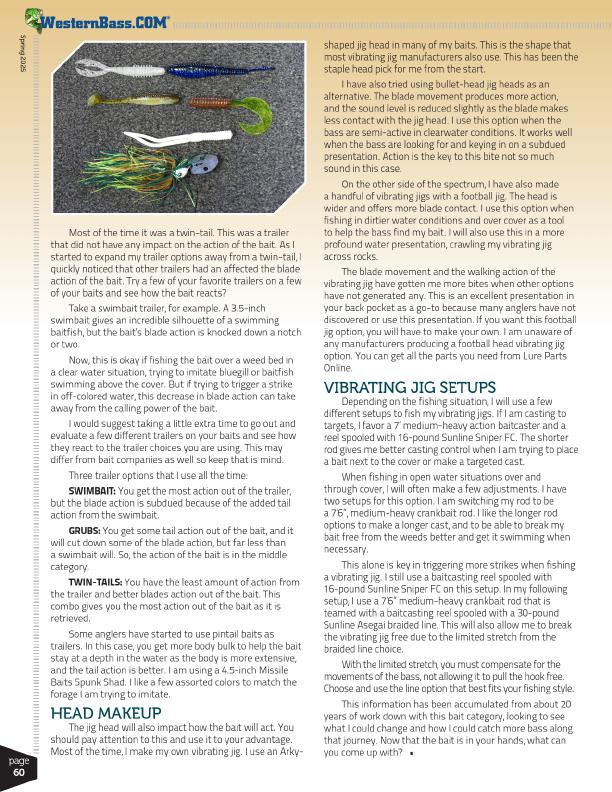
Most of the time it was a twin-tail. This was a trailer that did not have any impact on the action of the bait. As I started to expand my trailer options away from a twin-tail, I quickly noticed that other trailers had an affected the blade action of the bait. Try a few of your favorite trailers on a few of your baits and see how the bait reacts?
Take a swimbait trailer, for example. A 3.5-inch swimbait gives an incredible silhouette of a swimming baitfish, but the bait’s blade action is knocked down a notch or two.
Now, this is okay if fishing the bait over a weed bed in a clear water situation, trying to imitate bluegill or baitfish swimming above the cover. But if trying to trigger a strike in off-colored water, this decrease in blade action can take away from the calling power of the bait.
I would suggest taking a little extra time to go out and evaluate a few different trailers on your baits and see how they react to the trailer choices you are using. This may differ from bait companies as well so keep that is mind.
Three trailer options that I use all the time:
SWIMBAIT: You get the most action out of the trailer, but the blade action is subdued because of the added tail action from the swimbait.
GRUBS: You get some tail action out of the bait, and it will cut down some of the blade action, but far less than a swimbait will. So, the action of the bait is in the middle category.
TWIN-TAILS: You have the least amount of action from the trailer and better blades action out of the bait. This combo gives you the most action out of the bait as it is retrieved.
Some anglers have started to use pintail baits as trailers. In this case, you get more body bulk to help the bait stay at a depth in the water as the body is more extensive, and the tail action is better. I am using a 4.5-inch Missile Baits Spunk Shad. I like a few assorted colors to match the forage I am trying to imitate.
HEAD MAKEUP
The jig head will also impact how the bait will act. You should pay attention to this and use it to your advantage. Most of the time, I make my own vibrating jig. I use an Arky-
shaped jig head in many of my baits. This is the shape that most vibrating jig manufacturers also use. This has been the staple head pick for me from the start.
I have also tried using bullet-head jig heads as an alternative. The blade movement produces more action, and the sound level is reduced slightly as the blade makes less contact with the jig head. I use this option when the bass are semi-active in clearwater conditions. It works well when the bass are looking for and keying in on a subdued presentation. Action is the key to this bite not so much sound in this case.
On the other side of the spectrum, I have also made a handful of vibrating jigs with a football jig. The head is wider and offers more blade contact. I use this option when fishing in dirtier water conditions and over cover as a tool to help the bass find my bait. I will also use this in a more profound water presentation, crawling my vibrating jig across rocks.
The blade movement and the walking action of the vibrating jig have gotten me more bites when other options have not generated any. This is an excellent presentation in your back pocket as a go-to because many anglers have not discovered or use this presentation. If you want this football jig option, you will have to make your own. I am unaware of any manufacturers producing a football head vibrating jig option. You can get all the parts you need from Lure Parts Online.
VIBRATING JIG SETUPS
Depending on the fishing situation, I will use a few different setups to fish my vibrating jigs. If I am casting to targets, I favor a 7’ medium-heavy action baitcaster and a reel spooled with 16-pound Sunline Sniper FC. The shorter rod gives me better casting control when I am trying to place a bait next to the cover or make a targeted cast.
When fishing in open water situations over and through cover, I will often make a few adjustments. I have two setups for this option. I am switching my rod to be a 7’6”, medium-heavy crankbait rod. I like the longer rod options to make a longer cast, and to be able to break my bait free from the weeds better and get it swimming when necessary.
This alone is key in triggering more strikes when fishing a vibrating jig. I still use a baitcasting reel spooled with 16-pound Sunline Sniper FC on this setup. In my following setup, I use a 7’6” medium-heavy crankbait rod that is teamed with a baitcasting reel spooled with a 30-pound Sunline Asegai braided line. This will also allow me to break the vibrating jig free due to the limited stretch from the braided line choice.
With the limited stretch, you must compensate for the movements of the bass, not allowing it to pull the hook free. Choose and use the line option that best fits your fishing style.
This information has been accumulated from about 20 years of work down with this bait category, looking to see what I could change and how I could catch more bass along that journey. Now that the bait is in your hands, what can you come up with? •