Spring 2025
I
t doesn’t matter if it’s a lake or a river system, when
a bass fisherman drops his boat in and makes a
cast, it is almost a guarantee that a jig will be rigged on one of their rods.
The jig is a versatile lure and has been morphed into many designs that each have a specific purpose and application on the water. By having a better understanding of each jig design, and the size of the jig, you will be able to get the most out of that jig depending on the conditions you are faced with on the water that day.
In this article, we are going to look at the different types of SKIRTED jigs on the market, this means flipping, football, finesse and swim jigs.
FLIPPING JIGS
Often when an angler reports they caught fish on a jig, thoughts go to flipping jigs. Many of these types of jigs are purely designed for flipping heavy covers and have stiffer weedguards, while others use a sparser weedguard and can be cast and fished around offshore structure.
Regardless, flipping a jig around stumps, laydowns, boat docks or around vegetation, allows the angler to put the bait tight to the cover that the bass have positioned themselves to. From changing the size of your jig and varying what your trailer is, a jig is a very versatile choice for bass anglers to use on any body of water.
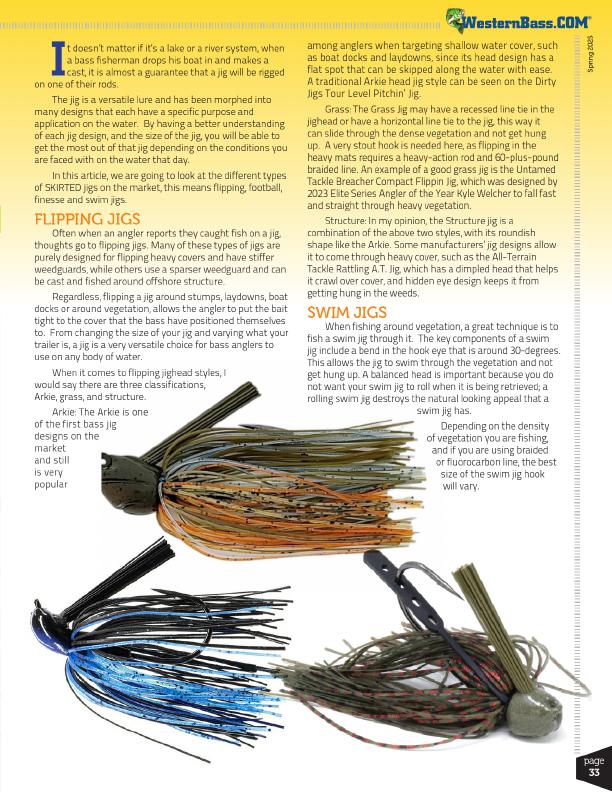
When it comes to flipping jighead styles, I would say there are three classifications, Arkie, grass, and structure.
Arkie: The Arkie is one of the first bass jig designs on the market and still is very popular
among anglers when targeting shallow water cover, such as boat docks and laydowns, since its head design has a flat spot that can be skipped along the water with ease. A traditional Arkie head jig style can be seen on the Dirty Jigs Tour Level Pitchin’ Jig.
Grass: The Grass Jig may have a recessed line tie in the jighead or have a horizontal line tie to the jig, this way it can slide through the dense vegetation and not get hung up. A very stout hook is needed here, as flipping in the heavy mats requires a heavy-action rod and 60-plus-pound braided line. An example of a good grass jig is the Untamed Tackle Breacher Compact Flippin Jig, which was designed by 2023 Elite Series Angler of the Year Kyle Welcher to fall fast and straight through heavy vegetation.
Structure: In my opinion, the Structure jig is a combination of the above two styles, with its roundish shape like the Arkie. Some manufacturers’ jig designs allow it to come through heavy cover, such as the All-Terrain Tackle Rattling A.T. Jig, which has a dimpled head that helps it crawl over cover, and hidden eye design keeps it from getting hung in the weeds.
SWIM JIGS
When fishing around vegetation, a great technique is to fish a swim jig through it. The key components of a swim jig include a bend in the hook eye that is around 30-degrees. This allows the jig to swim through the vegetation and not get hung up. A balanced head is important because you do not want your swim jig to roll when it is being retrieved; a rolling swim jig destroys the natural looking appeal that a
swim jig has.
Depending on the density of vegetation you are fishing, and if you are using braided
or fluorocarbon line, the best
size of the swim jig hook
will vary.
®
page
33