®
Spring 2025
page 22
column. Additionally, golden mussel bioaccumulates heavy metals and pesticides and may facilitate the transfer of these substances to existing fauna (not many of our existing fish fauna rely on mussels as forage).
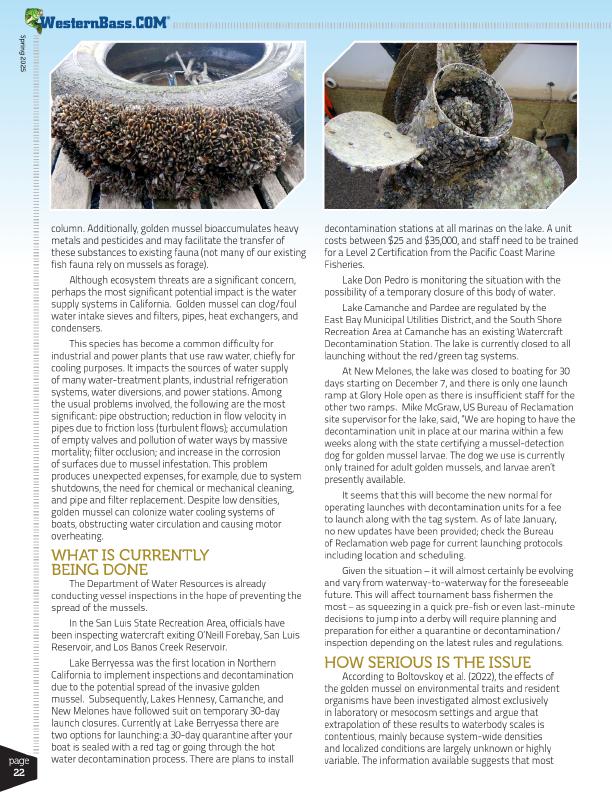
Although ecosystem threats are a significant concern, perhaps the most significant potential impact is the water supply systems in California. Golden mussel can clog/foul water intake sieves and filters, pipes, heat exchangers, and condensers.
This species has become a common difficulty for industrial and power plants that use raw water, chiefly for cooling purposes. It impacts the sources of water supply of many water-treatment plants, industrial refrigeration systems, water diversions, and power stations. Among the usual problems involved, the following are the most significant: pipe obstruction; reduction in flow velocity in pipes due to friction loss (turbulent flows); accumulation of empty valves and pollution of water ways by massive mortality; filter occlusion; and increase in the corrosion of surfaces due to mussel infestation. This problem produces unexpected expenses, for example, due to system shutdowns, the need for chemical or mechanical cleaning, and pipe and filter replacement. Despite low densities, golden mussel can colonize water cooling systems of boats, obstructing water circulation and causing motor overheating.
WHAT IS CURRENTLY BEING DONE
The Department of Water Resources is already conducting vessel inspections in the hope of preventing the spread of the mussels.
In the San Luis State Recreation Area, officials have been inspecting watercraft exiting O’Neill Forebay, San Luis Reservoir, and Los Banos Creek Reservoir.
Lake Berryessa was the first location in Northern California to implement inspections and decontamination due to the potential spread of the invasive golden mussel. Subsequently, Lakes Hennesy, Camanche, and New Melones have followed suit on temporary 30-day launch closures. Currently at Lake Berryessa there are two options for launching: a 30-day quarantine after your boat is sealed with a red tag or going through the hot water decontamination process. There are plans to install
decontamination stations at all marinas on the lake. A unit costs between $25 and $35,000, and staff need to be trained for a Level 2 Certification from the Pacific Coast Marine Fisheries.
Lake Don Pedro is monitoring the situation with the possibility of a temporary closure of this body of water.
Lake Camanche and Pardee are regulated by the East Bay Municipal Utilities District, and the South Shore Recreation Area at Camanche has an existing Watercraft Decontamination Station. The lake is currently closed to all launching without the red/green tag systems.
At New Melones, the lake was closed to boating for 30 days starting on December 7, and there is only one launch ramp at Glory Hole open as there is insufficient staff for the other two ramps. Mike McGraw, US Bureau of Reclamation site supervisor for the lake, said, “We are hoping to have the decontamination unit in place at our marina within a few weeks along with the state certifying a mussel-detection dog for golden mussel larvae. The dog we use is currently only trained for adult golden mussels, and larvae aren’t presently available.
It seems that this will become the new normal for operating launches with decontamination units for a fee to launch along with the tag system. As of late January, no new updates have been provided; check the Bureau of Reclamation web page for current launching protocols including location and scheduling.
Given the situation – it will almost certainly be evolving and vary from waterway-to-waterway for the foreseeable future. This will affect tournament bass fishermen the most – as squeezing in a quick pre-fish or even last-minute decisions to jump into a derby will require planning and preparation for either a quarantine or decontamination/ inspection depending on the latest rules and regulations.
HOW SERIOUS IS THE ISSUE
According to Boltovskoy et al. (2022), the effects of the golden mussel on environmental traits and resident organisms have been investigated almost exclusively in laboratory or mesocosm settings and argue that extrapolation of these results to waterbody scales is contentious, mainly because system-wide densities and localized conditions are largely unknown or highly variable. The information available suggests that most