®
P
eanut butter and jelly. Mornings and coffee.
Jerkbaits and Forward-Facing Sonar (FFS). If you
have a pulse and fish for bass, you know FFS and Damiki Rigs have dominated for the past couple of years.
Largemouth bass, smallmouth bass, spotted bass and others
have fallen victim to FFS. This new generation of electronics
exploits the offshore frontier to find the proverbial needle in the
haystack. Bass are now caught out of both sides of the boat
because FFS can spot them in open water.
This article and video will explain the effectiveness of the Damiki rig and FFS, but then adapt it to fishing hard jerkbaits with FFS to make your pre-spawn, spawn, and post-spawn fishing more successful.
WHAT IS THE DAMIKI RIG
First let’s review the Damiki rig and technique. While Damiki made the rig and technique famous (hence the name) there are variations and brands that often are generically referred to as Damiki rigs. The rig in simple terms is a jighead and soft plastic minnow that is usually meant to match and imitate shad baitfish.
Damiki rigs can be fished year-round, but excel during the late summer, fall, and early winter period when bass are eating schools of shad roaming around the lake in generally- deep water. This finesse tactic relies on its realism to match the hatch in clear water, and a jighead is necessary to both imitate shad and get it to the depths shad are roaming. The body of this rig is a soft plastic fluke-style bait that is typically three-inches in length and has a forked tail. The forked tail is important because it moves when this rig is fished very slowly suspending just above a school of bass.
RIGGING THE DAMIKI RIG
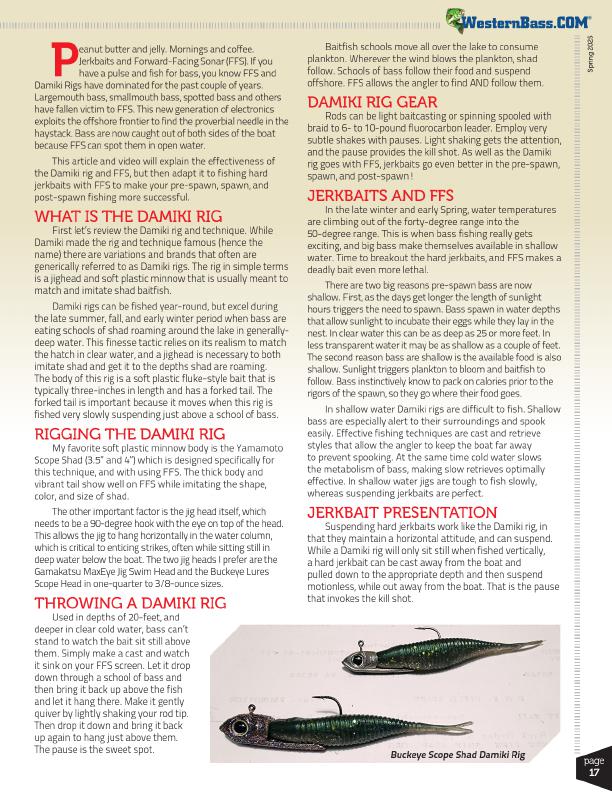
My favorite soft plastic minnow body is the Yamamoto Scope Shad (3.5” and 4”) which is designed specifically for this technique, and with using FFS. The thick body and vibrant tail show well on FFS while imitating the shape, color, and size of shad.
The other important factor is the jig head itself, which needs to be a 90-degree hook with the eye on top of the head. This allows the jig to hang horizontally in the water column, which is critical to enticing strikes, often while sitting still in deep water below the boat. The two jig heads I prefer are the Gamakatsu MaxEye Jig Swim Head and the Buckeye Lures Scope Head in one-quarter to 3/8-ounce sizes.
THROWING A DAMIKI RIG
Used in depths of 20-feet, and deeper in clear cold water, bass can’t stand to watch the bait sit still above them. Simply make a cast and watch it sink on your FFS screen. Let it drop down through a school of bass and then bring it back up above the fish and let it hang there. Make it gently quiver by lightly shaking your rod tip. Then drop it down and bring it back up again to hang just above them. The pause is the sweet spot.
Baitfish schools move all over the lake to consume plankton. Wherever the wind blows the plankton, shad follow. Schools of bass follow their food and suspend offshore. FFS allows the angler to find AND follow them.
DAMIKI RIG GEAR
Rods can be light baitcasting or spinning spooled with braid to 6- to 10-pound fluorocarbon leader. Employ very subtle shakes with pauses. Light shaking gets the attention, and the pause provides the kill shot. As well as the Damiki rig goes with FFS, jerkbaits go even better in the pre-spawn, spawn, and post-spawn!
JERKBAITS AND FFS
In the late winter and early Spring, water temperatures are climbing out of the forty-degree range into the 50-degree range. This is when bass fishing really gets exciting, and big bass make themselves available in shallow water. Time to breakout the hard jerkbaits, and FFS makes a deadly bait even more lethal.
There are two big reasons pre-spawn bass are now shallow. First, as the days get longer the length of sunlight hours triggers the need to spawn. Bass spawn in water depths that allow sunlight to incubate their eggs while they lay in the nest. In clear water this can be as deep as 25 or more feet. In less transparent water it may be as shallow as a couple of feet. The second reason bass are shallow is the available food is also shallow. Sunlight triggers plankton to bloom and baitfish to follow. Bass instinctively know to pack on calories prior to the rigors of the spawn, so they go where their food goes.
In shallow water Damiki rigs are difficult to fish. Shallow bass are especially alert to their surroundings and spook easily. Effective fishing techniques are cast and retrieve styles that allow the angler to keep the boat far away to prevent spooking. At the same time cold water slows the metabolism of bass, making slow retrieves optimally effective. In shallow water jigs are tough to fish slowly, whereas suspending jerkbaits are perfect.
JERKBAIT PRESENTATION
Suspending hard jerkbaits work like the Damiki rig, in that they maintain a horizontal attitude, and can suspend. While a Damiki rig will only sit still when fished vertically, a hard jerkbait can be cast away from the boat and pulled down to the appropriate depth and then suspend motionless, while out away from the boat. That is the pause that invokes the kill shot.
Buckeye Scope Shad Damiki Rig
Spring 2025
page
17