Spring 2025
®
might not get on a spot, or you might not get back on the spot you were on.”
Remarkably, though, he keeps his bait selections relatively conventional in the springtime. On higher tides, whether it’s the Potomac or the Delta, he says his number one big fish tool in the pre-spawn and spawn is a buzzbait. Beyond that, the front deck of his ranger is likely to have a Lucky Craft 1.5, a bladed jig, a wacky-rigged worm and a glide bait, nothing that every other angler doesn’t have. What’s key is adjusting his boat position and location. He has “high tide spots” and “low tide spots,” but noted that fish behavior in either or both may alter depending on both level and flow.
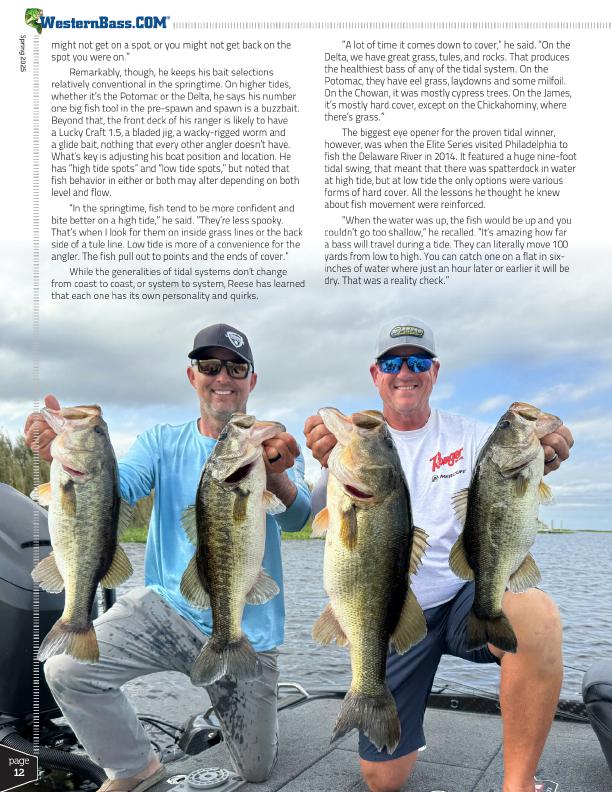
“In the springtime, fish tend to be more confident and bite better on a high tide,” he said. “They’re less spooky. That’s when I look for them on inside grass lines or the back side of a tule line. Low tide is more of a convenience for the angler. The fish pull out to points and the ends of cover.”
While the generalities of tidal systems don’t change from coast to coast, or system to system, Reese has learned that each one has its own personality and quirks.
“A lot of time it comes down to cover,” he said. “On the Delta, we have great grass, tules, and rocks. That produces the healthiest bass of any of the tidal system. On the Potomac, they have eel grass, laydowns and some milfoil. On the Chowan, it was mostly cypress trees. On the James, it’s mostly hard cover, except on the Chickahominy, where there’s grass.”
The biggest eye opener for the proven tidal winner, however, was when the Elite Series visited Philadelphia to fish the Delaware River in 2014. It featured a huge nine-foot tidal swing, that meant that there was spatterdock in water at high tide, but at low tide the only options were various forms of hard cover. All the lessons he thought he knew about fish movement were reinforced.
“When the water was up, the fish would be up and you couldn’t go too shallow,” he recalled. “It’s amazing how far a bass will travel during a tide. They can literally move 100 yards from low to high. You can catch one on a flat in six- inches of water where just an hour later or earlier it will be dry. That was a reality check.”
page
12