Fall 2026
®
original running characteristics. Going without a trailer reduces resistance further and can create a cleaner, faster presentation.
Trailer selection should therefore be considered part of depth and speed control, not simply a cosmetic addition.
HEAVY DOESN’T HAVE TO MEAN BIG
One of the most useful spinnerbait concepts is separating weight from profile.
A 3/4-ounce spinnerbait can be built around a compact head, relatively small blades and a trimmed skirt. The result is a small-looking presentation that can be retrieved quickly while remaining deeper in the water column.
Another spinnerbait can use a lighter head, oversized blades and a full skirt to create a much larger-looking presentation that naturally wants to ride higher. One weighs more, while the other looks bigger. Those don’t have to be the same bait.
3 HALF-OUNCE SPINNERBAITS, 3 DIFFERENT JOBS
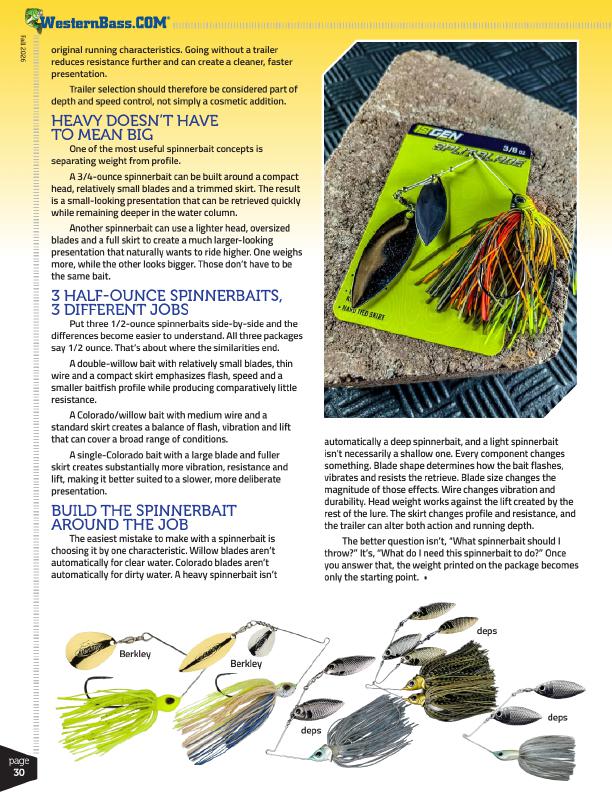
Put three 1/2-ounce spinnerbaits side-by-side and the differences become easier to understand. All three packages say 1/2 ounce. That’s about where the similarities end.
A double-willow bait with relatively small blades, thin wire and a compact skirt emphasizes flash, speed and a smaller baitfish profile while producing comparatively little resistance.
A Colorado/willow bait with medium wire and a standard skirt creates a balance of flash, vibration and lift that can cover a broad range of conditions.
A single-Colorado bait with a large blade and fuller skirt creates substantially more vibration, resistance and lift, making it better suited to a slower, more deliberate presentation.
BUILD THE SPINNERBAIT AROUND THE JOB
The easiest mistake to make with a spinnerbait is choosing it by one characteristic. Willow blades aren’t automatically for clear water. Colorado blades aren’t automatically for dirty water. A heavy spinnerbait isn’t
automatically a deep spinnerbait, and a light spinnerbait isn’t necessarily a shallow one. Every component changes something. Blade shape determines how the bait flashes, vibrates and resists the retrieve. Blade size changes the magnitude of those effects. Wire changes vibration and durability. Head weight works against the lift created by the rest of the lure. The skirt changes profile and resistance, and the trailer can alter both action and running depth.
The better question isn’t, “What spinnerbait should I throw?” It’s, “What do I need this spinnerbait to do?” Once you answer that, the weight printed on the package becomes only the starting point. •
Berkley
Berkley
deps
page 30
deps
deps