®
F
all doesn’t arrive on the same schedule
everywhere in the U.S. The eventual outcome may
be similar, but the timing and process can be very different. Where I live, fall begins to tighten its grip by the
end of September, while anglers on the West Coast may
not experience the same transition until the beginning of
December. One of the biggest regional differences affecting
frog habitat is the temperature range.
In the northern states, waters are susceptible to freezing temperatures later in the season. As those temperatures fall, frogs will often become dormant, settling into waterways and hibernating along the bottom through the colder months of winter.
As autumn brings shorter daylight hours, water temperatures begin to drop as well. These seasonal changes signal that it is time for the frogs to move toward larger bodies of water that will not freeze completely. Often, the first visible sign is large numbers of frogs crossing roads as they make their way back to these larger bodies of water.
In the Western part of the U.S., anglers generally aren’t faced with the lake-freezing temperatures common in the upper Midwest. Instead, the shortening length of daylight can become an important seasonal trigger. As the days grow shorter, frogs begin moving closer to larger bodies of water in preparation for the seasonal change ahead.
Rather than making the same movement driven by freezing conditions in the North, these frogs may concentrate along the shoreline and in slightly deeper water. Rocks and other shoreline cover provide places for them to hide, but they also put the frogs within striking distance of bass. A frog that ventures just a little too far into the water can quickly become an easy meal.
MATCH YOUR PRESENTATION TO AREAS YOU ARE TARGETING
When it is time to get on the water for the fall frog pattern, I usually depend on four baits. Which one I choose depends largely on the type of shoreline and cover I am fishing. Some of the waters I fish have several different types of cover, and each can lead me toward a different bait choice.
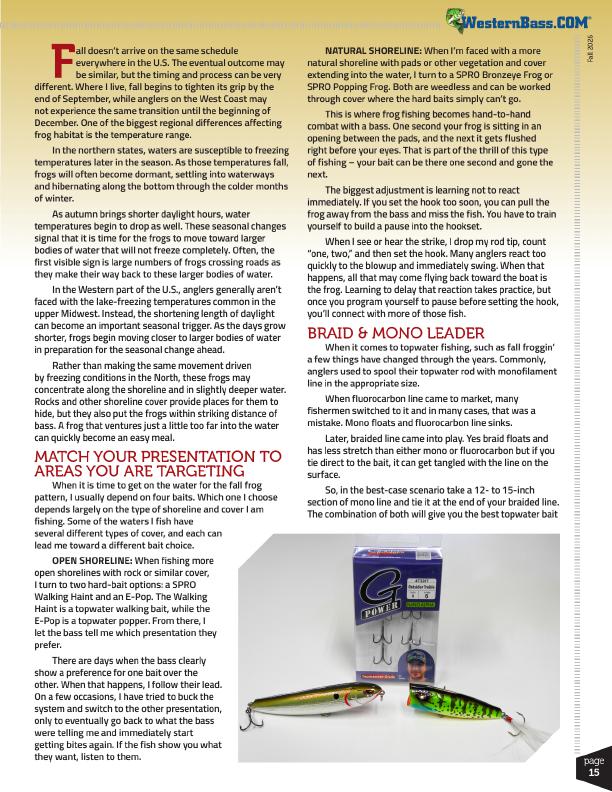
OPEN SHORELINE: When fishing more open shorelines with rock or similar cover, I turn to two hard-bait options: a SPRO Walking Haint and an E-Pop. The Walking Haint is a topwater walking bait, while the E-Pop is a topwater popper. From there, I let the bass tell me which presentation they prefer.
There are days when the bass clearly show a preference for one bait over the other. When that happens, I follow their lead. On a few occasions, I have tried to buck the system and switch to the other presentation, only to eventually go back to what the bass were telling me and immediately start getting bites again. If the fish show you what they want, listen to them.
NATURAL SHORELINE: When I’m faced with a more natural shoreline with pads or other vegetation and cover extending into the water, I turn to a SPRO Bronzeye Frog or SPRO Popping Frog. Both are weedless and can be worked through cover where the hard baits simply can’t go.
This is where frog fishing becomes hand-to-hand combat with a bass. One second your frog is sitting in an opening between the pads, and the next it gets flushed right before your eyes. That is part of the thrill of this type of fishing – your bait can be there one second and gone the next.
The biggest adjustment is learning not to react immediately. If you set the hook too soon, you can pull the frog away from the bass and miss the fish. You have to train yourself to build a pause into the hookset.
When I see or hear the strike, I drop my rod tip, count “one, two,” and then set the hook. Many anglers react too quickly to the blowup and immediately swing. When that happens, all that may come flying back toward the boat is the frog. Learning to delay that reaction takes practice, but once you program yourself to pause before setting the hook, you’ll connect with more of those fish.
BRAID & MONO LEADER
When it comes to topwater fishing, such as fall froggin’ a few things have changed through the years. Commonly, anglers used to spool their topwater rod with monofilament line in the appropriate size.
When fluorocarbon line came to market, many fishermen switched to it and in many cases, that was a mistake. Mono floats and fluorocarbon line sinks.
Later, braided line came into play. Yes braid floats and has less stretch than either mono or fluorocarbon but if you tie direct to the bait, it can get tangled with the line on the surface.
So, in the best-case scenario take a 12- to 15-inch section of mono line and tie it at the end of your braided line. The combination of both will give you the best topwater bait
Fall 2026
page
15