Fall 2025
®
scattered brush along it, or even just a ho-hum, barren mud or sand bank, keep in mind that fall bass can be using that shoreline as a migration path to their fall feeding area, or pending the time of day, push bait up on to that plain Jane bank to feed.
For situations like this, you want to use a topwater that allows you to cover water VERY quickly, not require an immense amount of cadence to the retrieve, and lastly not force you to switch the bait you are using based on the cover in front of you on that bank.
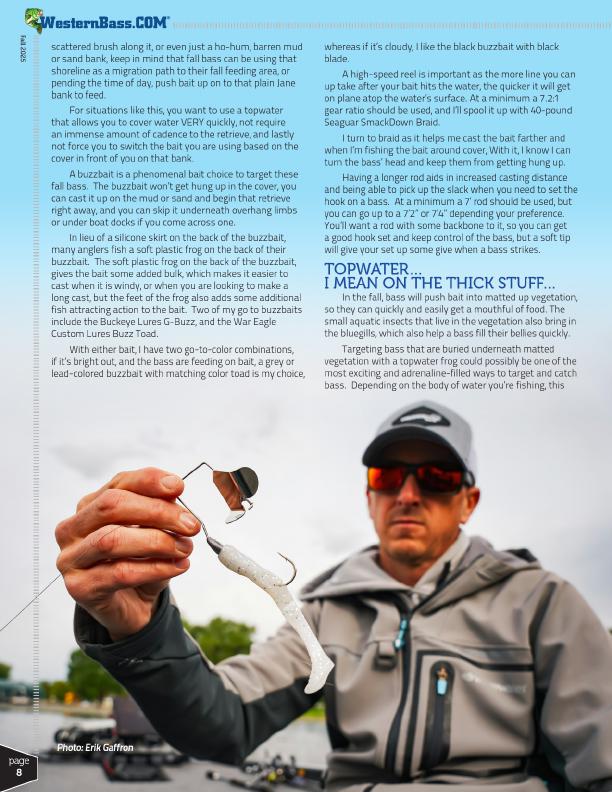
A buzzbait is a phenomenal bait choice to target these fall bass. The buzzbait won’t get hung up in the cover, you can cast it up on the mud or sand and begin that retrieve right away, and you can skip it underneath overhang limbs or under boat docks if you come across one.
In lieu of a silicone skirt on the back of the buzzbait, many anglers fish a soft plastic frog on the back of their buzzbait. The soft plastic frog on the back of the buzzbait, gives the bait some added bulk, which makes it easier to cast when it is windy, or when you are looking to make a long cast, but the feet of the frog also adds some additional fish attracting action to the bait. Two of my go to buzzbaits include the Buckeye Lures G-Buzz, and the War Eagle Custom Lures Buzz Toad.
With either bait, I have two go-to-color combinations, if it’s bright out, and the bass are feeding on bait, a grey or lead-colored buzzbait with matching color toad is my choice,
whereas if it’s cloudy, I like the black buzzbait with black blade.
A high-speed reel is important as the more line you can up take after your bait hits the water, the quicker it will get on plane atop the water’s surface. At a minimum a 7.2:1 gear ratio should be used, and I’ll spool it up with 40-pound Seaguar SmackDown Braid.
I turn to braid as it helps me cast the bait farther and when I’m fishing the bait around cover, With it, I know I can turn the bass’ head and keep them from getting hung up.
Having a longer rod aids in increased casting distance and being able to pick up the slack when you need to set the hook on a bass. At a minimum a 7’ rod should be used, but you can go up to a 7’2” or 7’4” depending your preference. You’ll want a rod with some backbone to it, so you can get a good hook set and keep control of the bass, but a soft tip will give your set up some give when a bass strikes.
TOPWATER… I MEAN ON THE THICK STUFF…
In the fall, bass will push bait into matted up vegetation, so they can quickly and easily get a mouthful of food. The small aquatic insects that live in the vegetation also bring in the bluegills, which also help a bass fill their bellies quickly.
Targeting bass that are buried underneath matted vegetation with a topwater frog could possibly be one of the most exciting and adrenaline-filled ways to target and catch bass. Depending on the body of water you’re fishing, this
page
8
Photo: Erik Gaffron