Fall 2025
®
Rig It: Use a flat-back friendly screw-lock swimbait hook or swimbait jighead, enabling weedless rigging and smooth flush profile. Tie it direct to the ring or use a loop knot for better action.
Color Tip: In clear water, HD Sexy Shad, HD Tennessee Shad, and Natural Shad are lifelike matches to local shad When the water is stained or murky, Sight Flash has stand-out contrast to attract attention.
for fall include small, compact creature baits or finesse grubs to boost profile and scent without overshadowing the jig’s flash.
Color Tip: For clear water, try natural options like Ghost Shad, Tennessee Shad, or Pros Pick. These blend well with forage. In stained water, choose high-contrast finishes like Burnt Orange, Chartreuse White, or Blerch to catch prolonged tracking fish.
DAIWA YAMAMOTO
COPPERHEAD BLADED JIG -
NEKO FAT - DAIWA
1 st GEN FISHING
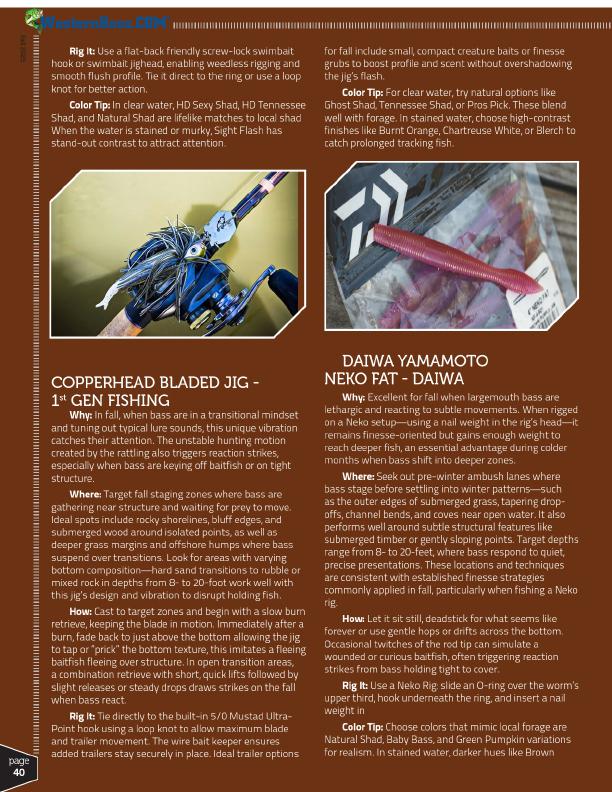
Why: In fall, when bass are in a transitional mindset and tuning out typical lure sounds, this unique vibration catches their attention. The unstable hunting motion created by the rattling also triggers reaction strikes, especially when bass are keying off baitfish or on tight
Why: Excellent for fall when largemouth bass are lethargic and reacting to subtle movements. When rigged on a Neko setup—using a nail weight in the rig’s head—it remains finesse-oriented but gains enough weight to reach deeper fish, an essential advantage during colder months when bass shift into deeper zones.
structure.
Where: Seek out pre-winter ambush lanes where
Where: Target fall staging zones where bass are gathering near structure and waiting for prey to move. Ideal spots include rocky shorelines, bluff edges, and submerged wood around isolated points, as well as deeper grass margins and offshore humps where bass suspend over transitions. Look for areas with varying bottom composition—hard sand transitions to rubble or mixed rock in depths from 8- to 20-foot work well with this jig’s design and vibration to disrupt holding fish.
How: Cast to target zones and begin with a slow burn retrieve, keeping the blade in motion. Immediately after a burn, fade back to just above the bottom allowing the jig to tap or “prick” the bottom texture, this imitates a fleeing baitfish fleeing over structure. In open transition areas, a combination retrieve with short, quick lifts followed by
bass stage before settling into winter patterns—such as the outer edges of submerged grass, tapering drop- offs, channel bends, and coves near open water. It also performs well around subtle structural features like submerged timber or gently sloping points. Target depths range from 8- to 20-feet, where bass respond to quiet, precise presentations. These locations and techniques are consistent with established finesse strategies commonly applied in fall, particularly when fishing a Neko rig.
How: Let it sit still, deadstick for what seems like forever or use gentle hops or drifts across the bottom. Occasional twitches of the rod tip can simulate a wounded or curious baitfish, often triggering reaction strikes from bass holding tight to cover.
slight releases or steady drops draws strikes on the fall
Rig It: Use a Neko Rig: slide an O-ring over the worm’s
when bass react.
upper third, hook underneath the ring, and insert a nail
Rig It: Tie directly to the built-in 5/0 Mustad Ultra-
weight in
Point hook using a loop knot to allow maximum blade
Color Tip: Choose colors that mimic local forage are
and trailer movement. The wire bait keeper ensures
Natural Shad, Baby Bass, and Green Pumpkin variations
page
added trailers stay securely in place. Ideal trailer options
for realism. In stained water, darker hues like Brown
40