Fall 2025
T
aking a closer look at bass fishing today,
participation is still growing, and with that, bass
are facing increasing pressure day in and day out. So, how do you get bass into the boat when the bite
gets tough?
Many anglers have turned towards using more finesse tactics to bridge the bite. One finesse presentation that many anglers are turning towards is a Ned rig. Yes, its’s still catching bass daily, but the numbers are starting to decline as the bass are becoming more conditioned to it, having seen it daily in many waters across the United States. So, if you are looking for another finesse category that can put bass in your boat when the bite gets tough, take a look at the hair jig.
Hair jigs have been a player in mid-west waters for many years, and yet it is a well-kept secret in many bass circles. Hair jigs are used in the mid-west to fish not only for bass but also for walleyes as well. In the early years, jig dressing was made from bucktail, chicken feathers, foxes, or rabbit hair. There was no synthetic hair material on the market at that time; all the jig making material choices were natural. Another point to bring up was that there was not a lot of attention to these materials outside of the mid-west either.
One of the first to let this mid-west secret out was Buck Perry, with his books and magazine articles in Fishing Facts. Truly , the In-Fisherman crew opened everyone’s eyes to hair jigs. They were one of the first to talk in detail about fishing bucktail jigs not only for walleye but for bass as well.
Even to this day, bucktail jig tactics and options are not talked about much. There is a handful of older anglers that have used hair jigs through the years but have kept this bait more of a secret outside of their inner fishing circle. The anglers who are finding out about the hair jig pattern are stumbling on it by accident or are being shown by another angler close to them.
HAIR JIG BREAKDOWN
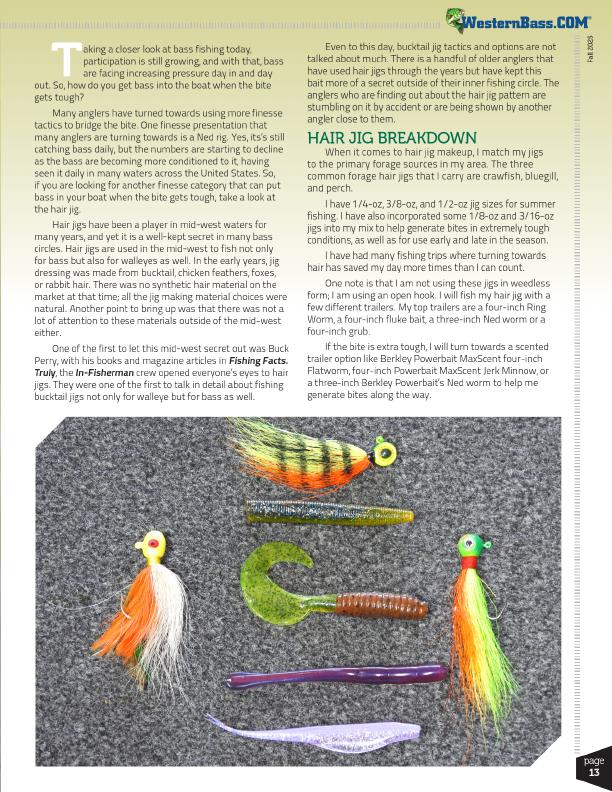
When it comes to hair jig makeup, I match my jigs to the primary forage sources in my area. The three common forage hair jigs that I carry are crawfish, bluegill, and perch.
I have 1/4-oz, 3/8-oz, and 1/2-oz jig sizes for summer fishing. I have also incorporated some 1/8-oz and 3/16-oz jigs into my mix to help generate bites in extremely tough conditions, as well as for use early and late in the season.
I have had many fishing trips where turning towards hair has saved my day more times than I can count.
One note is that I am not using these jigs in weedless form; I am using an open hook. I will fish my hair jig with a few different trailers. My top trailers are a four-inch Ring Worm, a four-inch fluke bait, a three-inch Ned worm or a four-inch grub.
If the bite is extra tough, I will turn towards a scented trailer option like Berkley Powerbait MaxScent four-inch Flatworm, four-inch Powerbait MaxScent Jerk Minnow, or a three-inch Berkley Powerbait’s Ned worm to help me generate bites along the way.
®
page
13